
 Pontsteigergebouw |
Booking a ticket online for the installation was proving difficult, the booking system just froze at a crucial point, so I decided to just go and try a blab my way in on the door.
I walked around to the ferry terminal, the area around the bakery was particularly busy. Two teenagers on an electric bike came charging along and must have clipped a stocky chap who was leaving the bakery. Immediately there was a lot of shouting in foreign tongues, none of it Dutch. The lads thought it all a joke but the chap was very serious about the matter. The lads jeered at him and shot off on the bike laughing, zipped across a road causing cars to brake sharply, and disappeared down an ally. The fellow was still steaming after this interaction. I can't say I've seen this sort of interaction before in Holland. Perhaps there was an element of racial tensions underlying this outburst.
The Fabrique des Lumieres was located in Westerpark, over the canal and half way to Sloterdijk. Public transport across to the park was lacking; it would be a good hike to get there. But I made a start by getting a ferry across to Pontsteiger.
 Drained Canal |
My hike began crossing a drained canal by Gevlebrug. A sad looking heron was standing on a pile of sand on the floor of the canal. For some reason the canal had been drained, perhaps whilst new flats were freshly built by the canal. Leaving the sorry state behind me, I walked through a large residential area, the leafy, up-and-coming neighbourhood of Spaarndammerbuurt. It was quite refreshing to walk past corner shops, small cafes, wine bars and restaurants with locals sitting gossiping outside, parents with children; totally lacking all the tourist trappings encountered in the city centre.
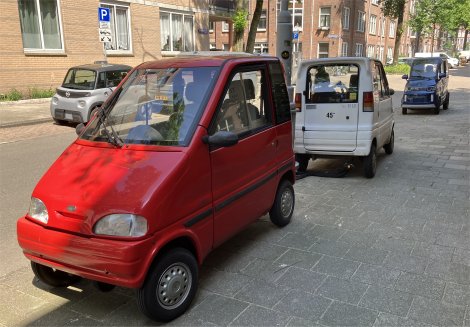 Ideal City Cars |
 Westerpark |
In 2003, the vision of Kathryn Gustafson, the American landscape architect who was hired to remodel the area, was finally completed: traditional Westerpark was extended into the Westergas, with a modern pond where children can play on hot summer days while their parents rest on the concrete beach or nearby sprawling lawn. Trees were planted and pathways/cycleways laid out.
 Mallards in Westerpark |
My amble brought me to the remains of the old 19th-century gasworks - the largest extraction plant in the Netherlands at the time - which closed down in 1967 after natural gas was discovered in the North Sea. Designed by renowned architect Isaac Gosschalk in popular Dutch neo-renaissance style, the remaining buildings of the gas plant were used as storage until they gained the status of national monuments in 1989. As new life was infused into the area by artists flocking to exhibit their work in the beautiful red-bricked, uncannily symmetrical buildings, the municipality turned its attention to cleaning up the grounds which were heavily polluted with by-products of gas production. It took years to rid the soil of the toxic substances but envisioning a larger park made sense. The area was gaining in popularity, and the adjacent neighbourhoods of Spaarndammerbuurt and Staatsliedenbuurt were gentrifying and developing a cultural life of their own.
 Westergas Gasworks |
 Pazzanistraat |
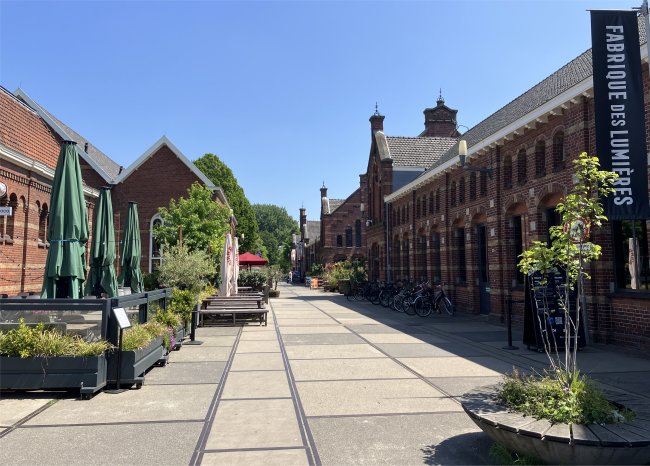 Pazzanistraat |
Today, the sprawling Westergas creative complex is one of the city's cultural powerhouses, forming a peaceful yet thrilling oasis of nature and entertainment, with an easy-going and independent flair. Permanent fixtures include trendy bars like Brouwerij Troost for the beer lovers and a slew of entertainment venues: DJ bar Radio Radio, art-house cinema Het Ketelhuis, and even a retro arcade bar Tonton Club. With plenty of booze and bites on offer, you'd be spoilt for food and drink options too.
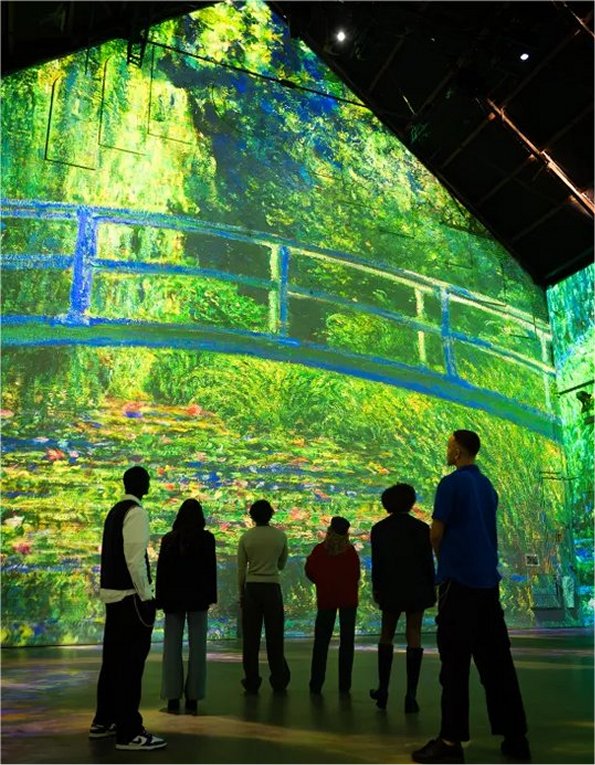 Inside Fabrique des Lumieres |
I strolled along Pazzanistraat between lovely brick buildings, surprisingly devoid of people; once part of the gasworks. Towards the end of the street I found the Fabrique des Lumieres. I entered, expecting to be told it was fully booked out, but a young woman said, "Just check in at the automatic booth, pay, and collect your receipt and ticket."
I thanked her, followed her instructions, and was soon winding my way through a maze of posters and display boards describing the whole area that was once an enormous gasworks. Then I entered a colossal room, with hidden projectors displaying digital images on the walls. A small number of benches were the only seating area. Surprisingly the room was sparsely occupied, with just a few people sitting on the benches, and others sitting on the floor. I have come across such immersive experiences before in London: the Lightroom and Frameless being examples.
I was really looking forward to this immersive experience since Monet was a pivotal figure in Impressionism, my favourite art movement. Impressionism is an art movement centred on capturing the fleeting visual impression of a moment and the effects of light and colour. With swift brushstrokes in shades of vivid colours, Monet captures this moment before it vanishes.
Claude Monet was born in Paris, but grew up by the water in Le Havre, Normandy, where he loved to capture the changing moods of the sea. With that, it's fitting that the exhibition begins with a night-time view of the harbour, with the depiction of boats' faint lights shimmering off in the distance. Gradually, like the slow rise of the sun, a new work appears: Impression, Sunrise. This view of the port of Le Havre, painted in 1872, was shown two years later at the first Impressionist exhibition in Paris. Perhaps it was too radical for some - the art critic Louis Leroy mocked it in Le Charivari: "I was just telling myself that, since I was impressed, there had to be some impression in it." His remark gave rise to the term "Impressionism", which would come to define an entirely new artistic movement.
This sensory immersive experience allowed the viewer to step into the dreamlike world of Claude Monet, the pioneer of Impressionism, and celebrate 150 years of this groundbreaking art movement. The experience was structured to guide the viewer through the life and selected masterpieces of the French painter, all accompanied by a mesmerizing soundtrack.
 Impression, Sunrise (1872) |
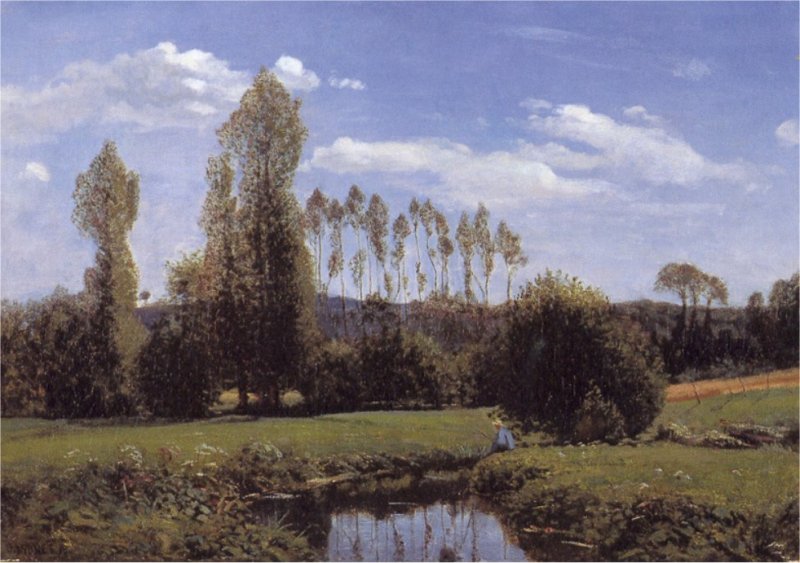 View of Rouelles (1858) |
The experience started of course with the painting that kick-started impressionism. From the slow rise of the sun at Le Havre, a new work appeared: Impression, Sunrise (1872).
Sleepy Landscapes:- Of course Monet was an artist well before imressionism got underway. Undeterred by the cold, Monet often painted outdoors in winter to explore the effects of winter light. Sunlight melts the snow and lush green spring returns. Here we see Monet's first painting View of Rouelles (1858), painted when he was just eighteen. It was Eugène Boudin who first introduced him to the art of painting in the open air.
 Gare Saint-Lazare (1877) |
 Belle-Île-en-Mer (1886) |
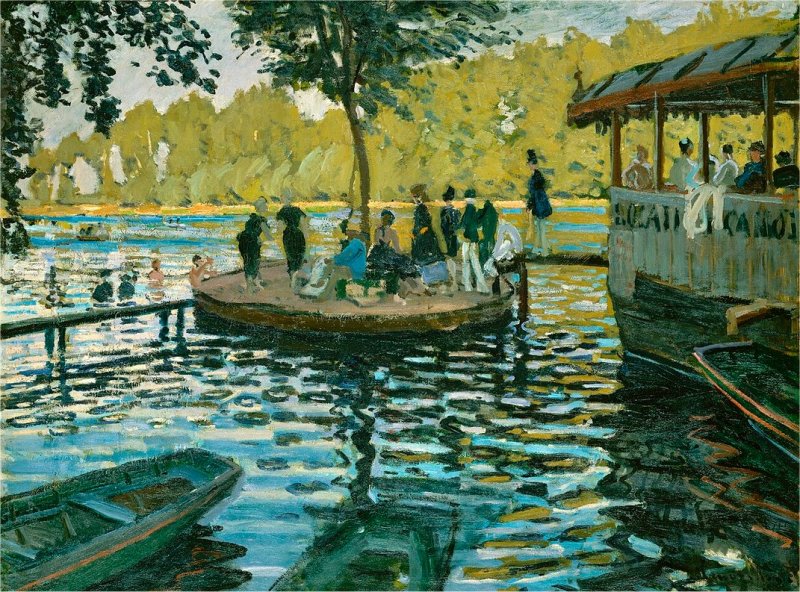 La Grenouillère (1869) |
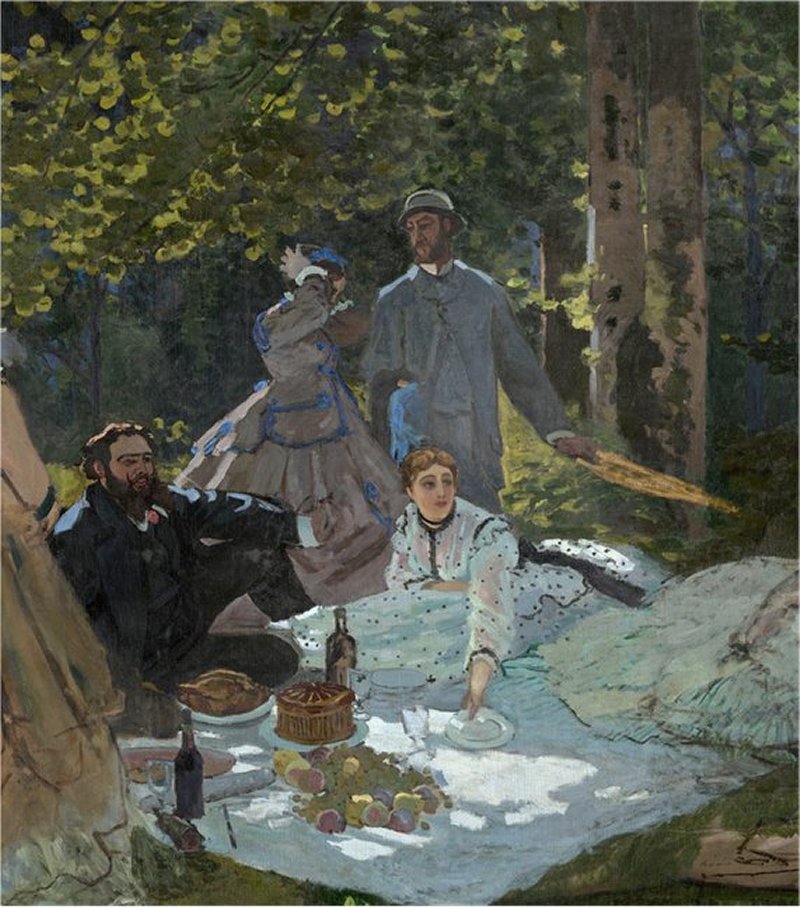 Le Déjeuner sur l'herbe (1865-1866) |
Full Steam Ahead:- In 1859 Monet returned to Paris to study at the Académie Suisse. From then on, he focused on capturing the movement and energy of the bustling capital. Napoleon III gave the city a fresh, modern look. The new steel structures offered Monet an exciting challenge. Gare Saint-Lazare (1877) became the starting point for a series of sketches.
The Beaches of Normandy:-The sea continued to call to him, and Monet painted beaches and seaside life in popular resorts at the close of the Second French Empire. Camille, his first wife, seeks shelter from the sun and wind beneath her parasol. The skies darken, and out of the wild Atlantic emerge the rocky formations of Belle-Île-en-Mer (1886). "I was used to painting the Channel ... but the ocean is something else entirely," Monet wrote in 1886 to his friend and fellow painter Gustave Caillebotte.
Go With the Flow:- Water and its reflections were a lifelong fascination for Monet. He always lived near the River Seine - in Paris, Le Havre, Argenteuil, Vétheuil and Poissy. In 1869 Monet set up his easel beside Renoir's to paint La Grenouillère (1869), a popular café-bal visited by the Parisian elite.
Gardens:- Gardens appear throughout Monet's career, tied to key moments in his life. From the gardens in Paris to those in Giverny, via Sainte-Adresse, Vétheuil and Montgeron, they offer glimpses into his domestic world. This sequence ends with the unfinished Le Déjeuner sur l'herbe (1865-1866), painted by a young Monet in 1865. The ambitious work proved too costly to complete, but he kept the surviving fragments of the painting until his death.
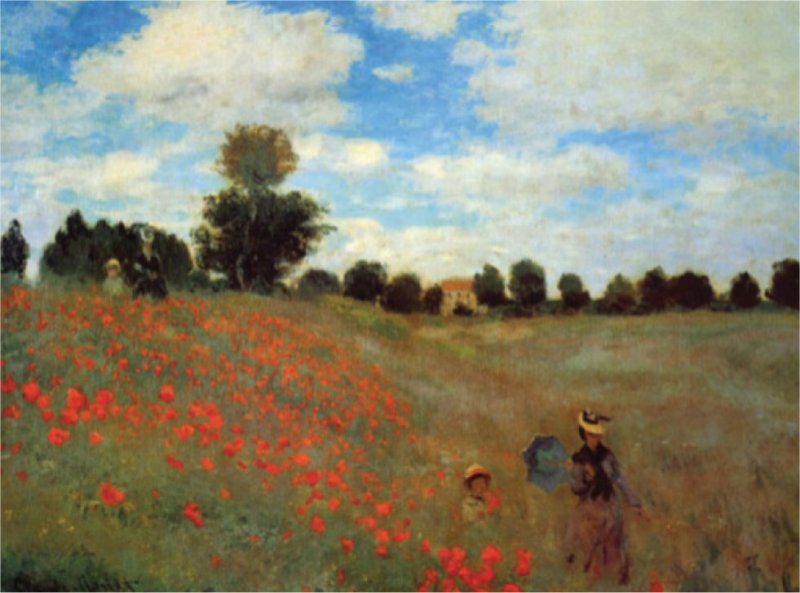 The Poppy Field near Argenteuil (1873) |
 San Giorgio Maggiore at Dusk (1908) |
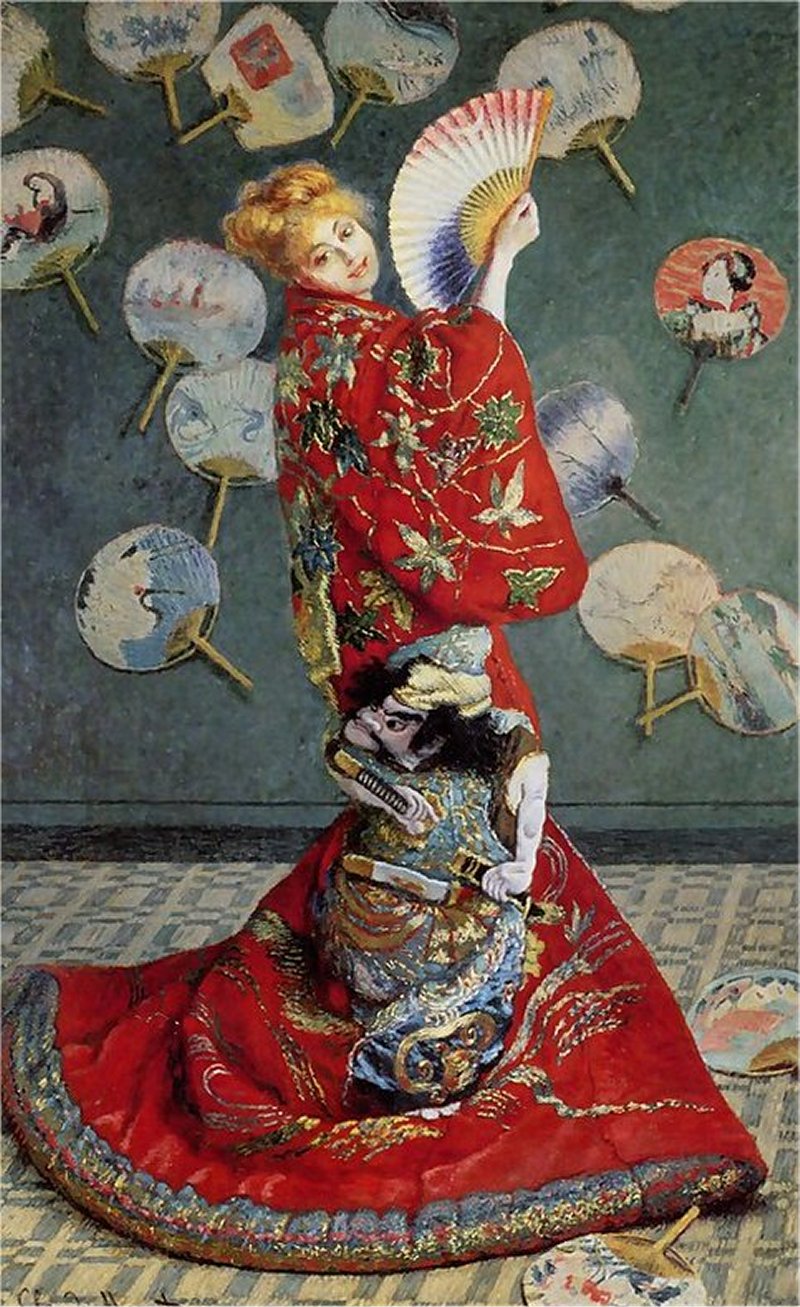 La Japonaise (1876) |
A Walk in the Countryside:- Poppies, drifting clouds and rustling leaves gave Monet the freedom to experiment with spontaneous brushwork. Colours burst into life, contours dissolve - the focus is not on precision, but on the visual impression of the moment. Parasols flutter and scarves catch in the wind as Monet captures the charm of a summer stroll through the country fields in his painting The Poppy Field near Argenteuil (1873).
The Mediterranean:- In 1883 and again in 1888, Monet visited the Antibes region and northern Italy. Under his lively brush, the Mediterranean sparkled, and his colours became more radiant. The lush gardens of Bordighera inspired him to create around forty works. In 1908 Monet discovered Venice, which he painted San Giorgio Maggiore at Dusk (1908) in exuberant variations of purple, pink and orange. Here too, water dominates his compositions.
Japonism:- When Japan pened to Western trade in the mid-19th century, collectors and artists alike became fascinated. Monet acquired more than 200 Japanese prints, which he displayed in his home at Giverny. His work La Japonaise (1876) features his first wife, Camille, wearing a blonde wig and holding a tricolour fan - a playful contrast between a Parisian woman and the Japanese objects surrounding her.
 Haystacks at Dawn (1891) |
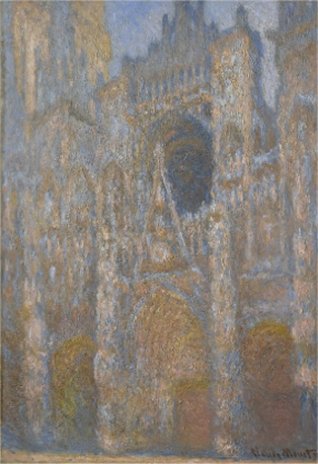 Rouen Cathedral, The Façade in Sunlight (1894) |
Series:- The Haystacks marked a turning point in Monet's career. The series was a huge commercial success, greatly enhancing his reputation. The poplars, which appear in the background of his poppy-field paintings, became the subject of another series, exploring the rhythm of vertical lines. Between 1892 and 1894 he added his Rouen Cathedral series, capturing the building's ever-changing appearance according to the light, the weather, and the time of day. His final series portrayed the Houses of Parliament and Waterloo Bridge in London, both shrouded in the misty, industrial atmosphere of the Thames.
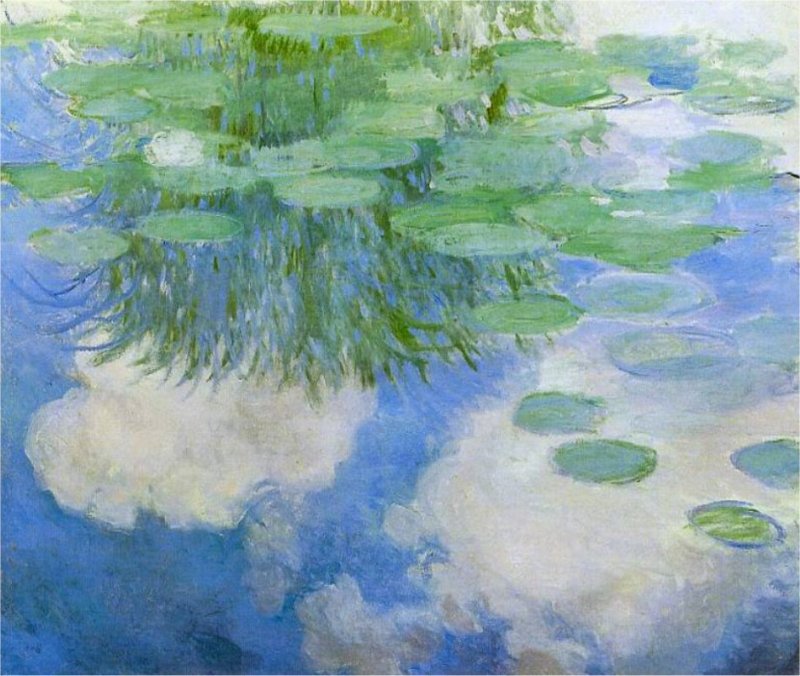 The Water Lilies |
Giverny and the Waterlilies:- From 1883 until his death in 1926, Monet lived in Giverny. The garden he created there gave rise to two of his most iconic subjects: The Japanese Bridge and The Water Lilies. They became an endless source of inspiration, painted in countless variations, from small canvases to monumental works. During the First World War, Monet worked on vast panels, which he gifted to the French state after the Armistice. Since 1927, they have been on display at the Musée de l'Orangerie in Paris. Claude Monet died in Giverny on 5 December 1926, aged 86. He played a defining role in the history of modern art. As leader of the Impressionist movement - where the experience of the moment mattered more than literal representation - he paved the way for a freer, more personal approach to painting. Surviving photographs offer a final tribute to the man behind the paintings.
 Woman with a Parasol (1875) |
Woman with a Parasol:- Camille Doncieux, Monet's first wife, stands on a hillside with their son Jean behind her. Monet painted the scene quickly, likely in a single session. He sketched the sky with lively blue and grey brushstrokes, leaving parts of the canvas bare, giving the work an airy vibrancy. The grass is painted more densely, with short strokes of green, blue, and brown. Touches of yellow suggest buttercups. Sunlight glints of the back of her skirt and jacket.
Breaking with the rigid conventions of academic portraiture, Monet painted his figures with the same freedom as their surroundings. In doing so, he conveys the soft breeze, the warmth of the sun, and the fleetingness of the moment. When shown at the second Impressionist exhibition in 1876, the painting's spontaneity and natural charm were widely praised.
 Rousseau - Jungle of Dreams |
Rousseau - Jungle of Dreams
In addition to the Monet experience, a short Rousseau immersive experience was tagged on. Henri Rousseau drew his inspiration from the Jardin des Plantes in Paris. Thanks to his vivid imagination, he could conjure up visions of jungles and exotic plants - despite never setting foot outside France. Known as "Le Douanier Rousseau" (for his many years working as a customs officer), he was self-taught, having never studied at an art academy.
This immersive experience allowed me to be carried away by a visual and acoustic adventure, surrounded by industrial-era Paris and the lush landscapes of another world. I flew over the city in a hot-air balloon and followed the course of the Seine, before making my way through a mysterious jungle brimming with vivid flora and fauna. Here, anything was possible: carnival characters danced through a mysterious, dark forest and suddenly the hypnotic eyes of a tiger gleamed from between the ferns. This reminded me of the time I showed my youngest granddaughter, Robin, Tiger in a Tropical Storm or Surprised! by Rousseau in London's National Gallery.
In the Studio, adjacent to the main Hall, yet another immersive experience was being held in conjunction with the Mauritshuis museum in The Hague, where Vermeer's famous painting Girl with a Pearl Earring is on display. #mygirlwithapearl - The Immersive Edition is a new exhibition which reimagines the timeless beauty of the 17th century masterpiece for the present day, offering a fresh and original take this iconic work of art.
For 7 minutes, thanks to state-of-art projections and a specially designed soundtrack, I was immersed in many modern interpretations of Girl with a Pearl Earring submitted by people from around the world. This total audiovisual experience highlights how Vermeer's masterpiece continues to captivate to this day, in a beautiful symbiosis of old and new.
 Girl with a Pearl Earring - The Immersive Edition |
I left the exhibitions, enjoyed a break at a nearby café and sipped fresh mint tea, and watched people and cyclists passing by, lads playing football in the park, and convoys of trains heading to and from Centraal Station.
 Haarlemmerpoort |
I crossed the Singelgracht via Willemsbrug, walked through the grand arch into Haarlemmplein and started the long hike down the long Haarlemmerdijk. This thoroughfare was crammed with shops, cafes, bars, restaurants and people along its entire length, offering an excellent vignette on Dutch city life. Being fairly peckish at the end of this journey, I devoured a Pad Thai before heading back to NDSM.
I found Rex catching the rays in the cockpit. He had chilled out again through the day and caught up with his reading. Entertainment was on hand nearby. We watched a coot build a nest on the swimming platform on the stern of a nearby boat. His construction materials were ingenious: a takeaway carton, straw, plastic, twigs and a variety of other floating objects polluting the marina. Good luck to the bird we thought.
We returned to the Van de Werf for our final evening meal in Amsterdam. Before ordering food, we enjoyed a few beers at an outside table, with Rex smoking away of course. It was then that I noticed a couple sitting behind Rex, in particular the young woman was looking down to what appeared to the base of Rex's back, and she was smiling. She said something to her young man, and he turned around to look too. I was intrigued as to what they were looking at. I caught her eye, and she smiled.
"I was wondering how long you have been here," she chuckled. I was bewildered, and she spotted I was at a loss. "The pile of cigarettes below your friend," she said, pointing to the mound of cigarette stubs around Rex's ankles. I laughed with the young woman, Rex was bemused. I'm certain they weren't all his.
After a hearty meal, we returned to Duonita, and worked out a strategy for tackling rogue Russian warships in the North Sea, should we have the misfortune of having an issue with one.