
A cargo ship heading to Kiel was my main concern as I took over the watch. The vessel kindly performed a small course adjustment to give good sea space between us. The handful of other ships around us did not pose any threat. I watched the sun pop his head over the horizon like a glowing red ball; another glorious, peaceful sunrise at sea, while Rex issued zizzes from his pit.
 Beautiful Peaceful Sunrise |
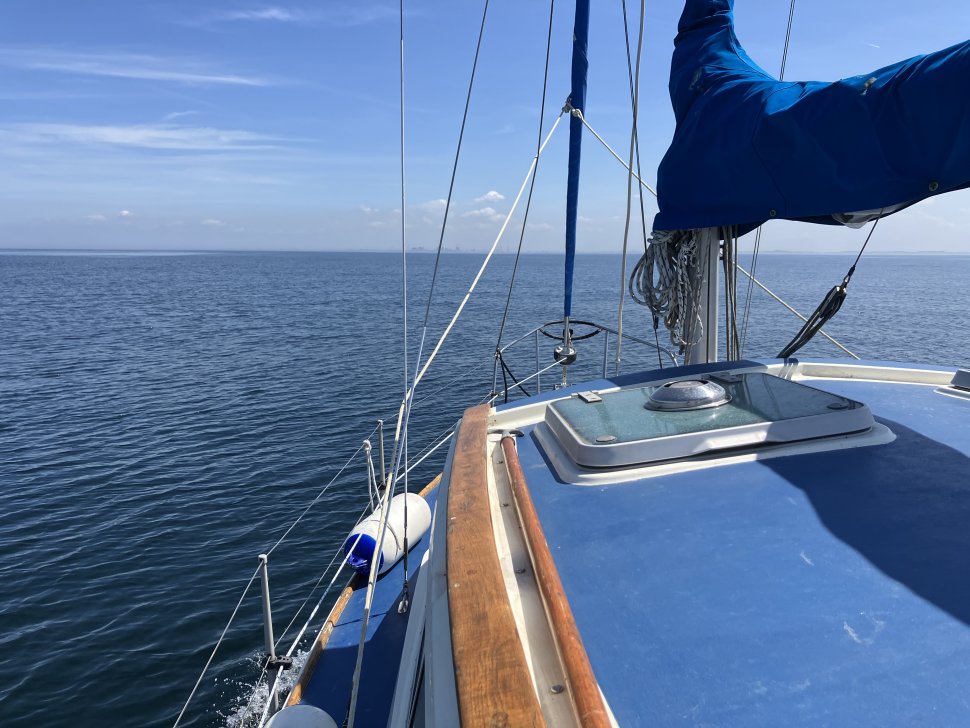 Ijmuiden on the Horizon |
After the German invasion of the Netherlands on 10th May, 1940, the Dutch Royal family left the country from Ijmuiden in the late evening of 12th May, on board the British destroyer HMS Codrington. The quays at Ijmuiden were crowded at that time with people desperate to be transported across the channel, sometimes at great expense. During the German occupation, the canal was out of operation and the Germans destroyed most of Ijmuiden to create what they called Festung Ijmuiden (Fortress Ijmuiden), a heavily defended area in which the entire civilian population had been removed. Ijmuiden became the site of two separate fortified pens constructed by the German navy to house their Schnellboote (fast torpedo boats, known to the Allies as "E-boats") and Biber midget submarines.
Entering the Marina Seaport Ijmuiden, we weaved our way to a long pontoon where we could berth as visitors. Once safely secured, I headed off to find the harbour master to pay our dues for the night, and arrange to meet up with the Royal Marechaussee, the national gendarmerie force of the Netherlands, performing military and civilian police duties. These are the chaps who could stamp our passports.
I discovered the harbour master was only available between 1600 - 17:00. After chatting with a few Dutch sailors, I learned we could register our stay via a QR code. Then, after a couple of attempts at contacting the Marechaussee, I arranged for the local force to drive over and stamp our passports. Two young men turned up on time in 15 minutes. They took our preprepared paperwork, all completed to remove all unnecessary hassle for both us and them, they took our photos as part of the compulsory biometric input into their systems. They apologised that they did not have portable finger print reading devices yet, and then they stamped our passports. An amiable couple of lads who probably welcomed the trip out.
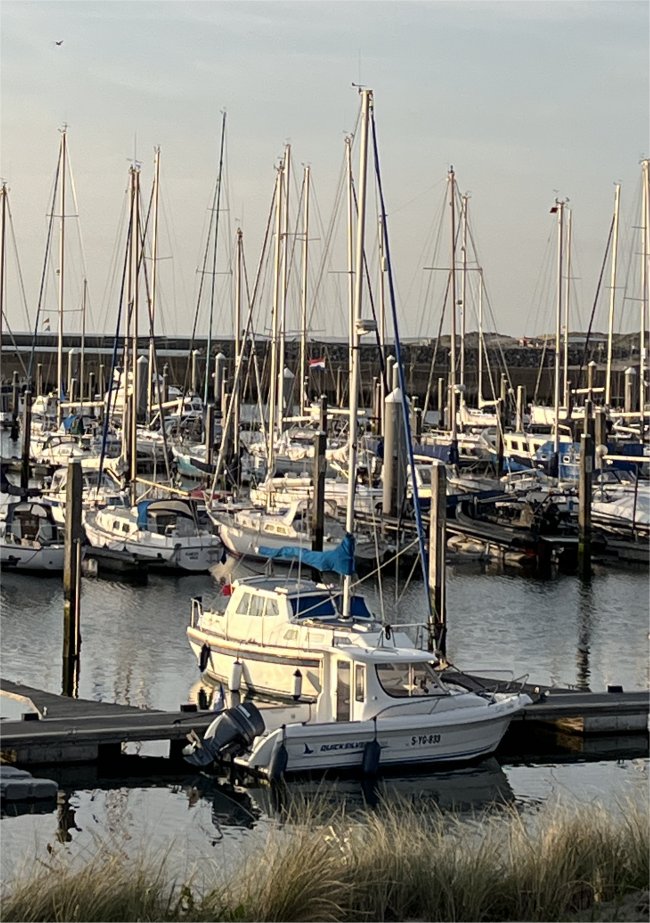 Duonita in Marina Seaport Ijmuiden |
"How does a Dutchman know about the Isle of Man?" I asked.
"I attended a magic convention there," Herman replied.
We soon discovered he was a magician who had once worked with several famous magicians in the past. One of the walls in the restaurant contained an array of large portrait photos of some of these magicians including Hans Kazan and Hans Klok. He had even studied with Paul Daniels. I later learned that Herman was a Dutch humorous magician, who had won several first prizes at domestic and foreign magic congresses. Between 1988 and 2002 he was a demonstrator and the face of Jan Monnikendam's MagicShop, the most famous magic shop in the Netherlands. During that period, he was a consultant for various magic shows and television programs. From 2014 he has been organizer of the Boulevard of Magic in Ijmuiden, which takes place every year on the first day of Pentecost.
"I took a taxi across the island one day," he related as he thought back to his stint on the Isle of Man. "On reaching the Elfin Bridge, the taxi driver waved a special wave as we crossed the bridge. I asked him what that was about. He replied it was to appease the elves."
He continued, "Later, on the way back, I had a different taxi driver, a man from Pakistan. He just clutched the steering wheel with both hands as we crossed the same bridge, and raised the index fingers on both hands." He then laughed out loud and giggled.
We returned later, enjoyed a few beers, food and banter with Herman. Rex pursued a line of thought with him re the different European languages. Herman's view was that there is a lot of commonalities between the northern European languages. I agreed wholeheartedly with that sentiment. Over the last couple of millennia armies have overrun neighbouring nations, and traders have criss-crossed the globe, so it is only natural that languages become blended. If we look at Britain, we had the Celts, Romans, Saxons, Vikings and French invasions. At the same time we have deposited our language in North America. Africa, India and Australasia. As I grew up I started to recognise that a lot of Cumbrian expressions I spoke as a child were purely Scandinavian. I pointed out to Herman that to me, Dutch and German are very similar, but I could not fathom out why Germans refused to speak Dutch. He agreed that the Germans refuse to speak Dutch. On the other hand, Herman considered Dutch to be more akin to English. Rex raised views expressed by Bill Bryson on the commonality of languages. We did not reach a consensus, but enjoyed the discussion.
 Beers in Het Zandhuis |