
The Noordzeekanaal is a waterway in the Netherlands that extends in an east-west direction between Amsterdam and Ijmuiden on the North Sea coast. Its construction was first proposed in 1852; work started in 1865; and the canal opened in 1876. It has been enlarged several times. Navigable by 90,000-ton oceangoing vessels, the canal is 24km long, 15m deep, and 235m wide. It gave Amsterdam access to the sea and made it a major port. The sea locks at Ijmuiden were destroyed during World War II but were later rebuilt; the largest is now 400m long by 50m, wide. The canal ends at Amsterdam in the closed-off Ij bay, (the Ijmuiden name literally means "mouth of the Ij"), which in turn connects to the Amsterdam-Rhine Canal.
To the north of the sea locks stood the Tata Steel IJmuiden. One of the original motivations for the creation of a steelworks was to end the country's reliance on imported steel. Since the country's resources of coal and iron ore were limited, a site suitable for import and export by sea was chosen, and Ijmuiden was chosen over sites at Rotterdam and Moerdijk due to better ground conditions. The site was on the north bank of the Noordzeekanaal outside its sea locks, and two harbours were built - the inner harbour opened in 1920, and the outer harbour in 1923.
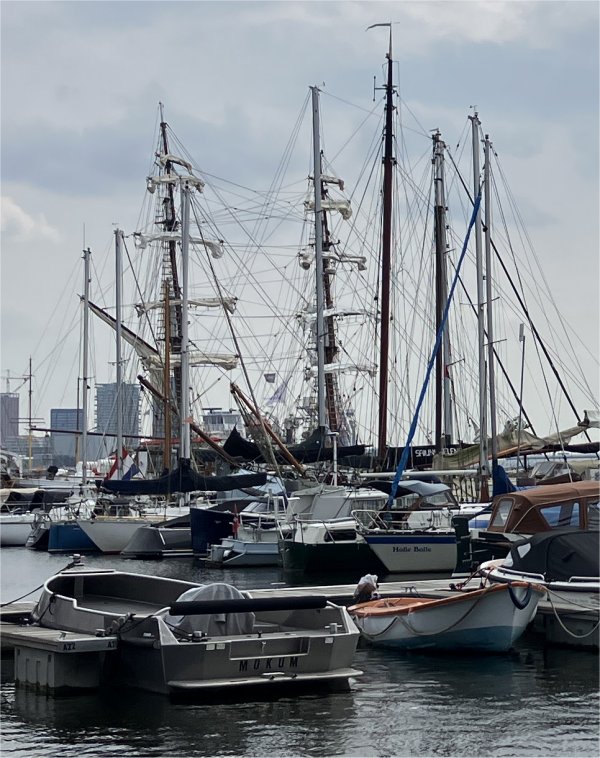 Array of Masts by NDSM Wharf |
As we progressed down the canal, the steelworks disappeared from view, and its banks gave way to gentle countryside. Fleets of planes flew over the canal heading towards Schiphol. Since it was Sunday, there was not much commercial traffic on the canal. Soon we were passing the entrances to a string of harbours on the canal's southern bank. It pays to concentrate in this area; large ships, barges and numerous other craft have a habit of shooting out unannounced.
We pondered for a while about heading straight on to Enkhuizen, but with a further bridge and locks to negotiate we wouldn't reach Enkhuizen before 8pm. We knew staff at Enkhuizen marina clocked off at 5pm, so we made the executive decision to stay in the Amsterdam Marina for the night.
Once ensconced in our berth in the marina, I enquired of the harbour master where I could find a hardware store; a loud speaker in the cockpit had become detached, requiring a purchase at such a store to effect a repair. He pointed out a store about 39 minutes' walk away. After informing Rex what I was getting up to, I set off on my hike.
After a short distance past the NDSM ferry terminal, I found myself passing by an enormous building that once belonged to NDSM. It was covered in colourful paintings and graffiti, as was a lot of the area; a sort of hippy paradise. Opposite the building was a large patch of wasteland on which hundreds of stalls had been set up selling all manner of goods. This Sunday market was heaving with people, the place was buzzing, and was obviously the place to come to and be seen.
I weaved my way through the masses on my mission and eventually found the Karwei store on Klaprozenweg. It was an Aladin's cave and contained everything a DIY enthusiast could wish for. I made my purchase. Incidentally, Klaprozenweg was where a temporary camp, Ataturk, was built to house several hundred "guest workers", mainly from Turkey, who were brought in during the '60s and '70s to solve the labour shortage in the shipyard.
Happy as a sandboy, I retraced my steps through the NDSM district, known as NDSM Wharf, a neighbourhood that has loudly reinvented itself over the past few decades. Once the beating heart of Amsterdam's shipbuilding industry, NDSM is now a cool and gritty jewel of the city - an Amsterdammer's go-to spot for second-hand hauls and trendy new waterfront spots. With its industrial architecture, galleries and art spaces, NDSM has cemented its status as a creative quarter for those seeking excitement beyond the city centre.
The Nederlandse Scheepsbouw Maatschappij (NSM) was building ships in Amsterdam since 1894. Not long after it was founded, the former VOC shipyard in Amsterdam East turned out to be too small for the ships that were built there. The NSM moved to the north side of the Ij where three slipways and the large shipbuilding shed were built in 1920. In 1946 the NSM and the adjacent Nederlandse Dok Maatschappij formed a partnership under the name Nederlandse Dok en Scheepsbouw Maatschappij (Dutch Dock and Shipbuilding Company) : the NDSM was born.
 NDSM in its Heyday |
In its heyday, more than 6,000 people worked at the NDSM, many their entire lives. The ships they made - freighters, luxury passenger ships, warships, tankers, mammoth tankers - went around the world. But after many successful years, The NDSM ran into difficulties in the 1960s and '70s due to the oil crisis and competition from Asia. In 1984 the shipyard closed for good.
Drawn in by the exciting potential (and cheap rent) of this disused space along the river, artists and students soon flocked to reclaim its empty spaces. Transforming former hangars and warehouses into homes and ateliers, the face of NDSM radically changed to reflect its new inhabitants. To preserve the site, Kinetisch Noord, an art foundation firmly rooted in the rebellious squatting spirit of the 1980s, became involved in 2001, and - with support from the city council - the area became one of Amsterdam's official broedplaatsen (breeding grounds for creativity and experimentation). The NDSM was here to stay.
 New Lease of Life for the NDSM Loods |
Pride of place was the plate bending machine and framing floor. The plate bending machine is one of the few machines from the shipbuilding era still present in the NDSM Loods. It was used to make curves in steel plates for the bilge, the part of a ship where the bottom meets the side wall. The op steel roller was adjusted to size and then a steel sheet was fed horizontally over two steel rollers and passed under the top roller. The downward pressure of the roller created a curve in the plate. By moving back and forth, and further adjusting the roller, the desired roundness was finally obtained. This particular bending machine was made by the Scottish Machine Tool Corporation in Glasgow, and brought to the NDSM in the 1950s. Standing next to this huge machine transported me back to 1969, when as a lad working at the Workington Iron and Steel Company, I would watch long lengths of snake like rail lines being straightened out by an equally colossal straightening machine.
 Plate Bending Machine |
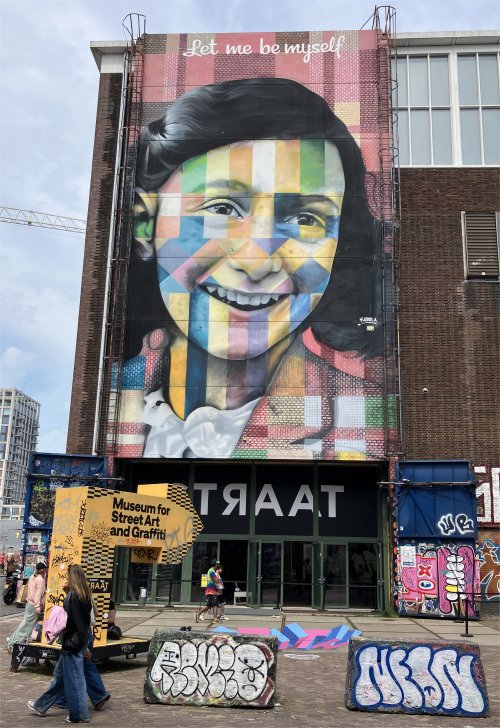 Anne Frank Portrait |
Since we were last here, a few more eating establishments had sprung up in the vicinity of the NDSM ferry terminal. We investigated: Korean chicken fast food, an enormous pizza establishment, ice cream parlours, Mexican salsa etc. Should we catch a ferry to the city we thought. The issue with the latter is that once you reach the Centraal Station there is still a fair hike to find decent restaurants. We put our heads into the De Baanderij restaurant, a place I had been to before with Dan, Oliver and James. It suited Rex, so we took up residence and ordered Cordonbleu ham, spinach and frites. That, plus a few beers, went down well. A large cruise ship glided along the canal in front of us; perhaps the banning of cruise ships in central Amsterdam had not been enforced yet.
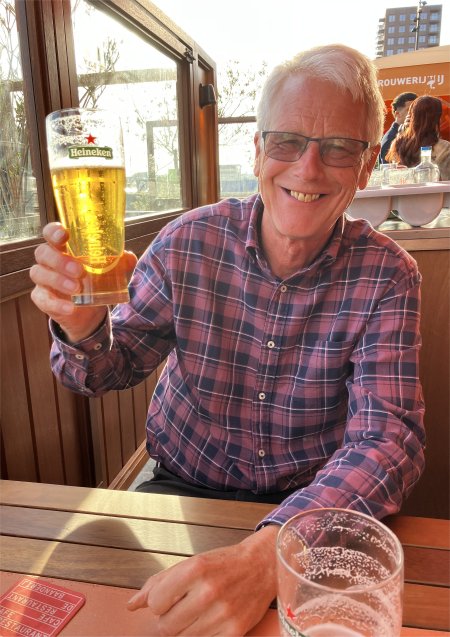 Cheers from Baanderij |
She gave us a perplexed look. Were we two old fools sailing all that way across the North Sea, or was it obvious we were suffering from early onset of dementia. She tactfully replied, "I couldn't do that neither, I get seasick."