
Job accomplished, we cleaned ourselves up and then marched off to the harbour train station to catch a train to Leeuwarden. On arrival at the station we found the ticket machine had gone on strike. A chap wandering in the vicinity pointed out we could just tap a credit card on a nearby reader stand, and tap out at our destination; a bit like an Oyster Card really. We duly tapped in. Sadly the poor chap was stuck; it would not read his card. Rex kindly offered to pay for his ticket, but the fellow refused to accept his offer.
We sped along past flat, green, water-logged fields laced with ditches. Many fields were populated with cattle, sheep, horses and sprouting crops. There were enough wind turbines to make it seem as if we were Lilliputians travelling through a field full of dandelions. In next to no time, we entered the city of Leeuwarden; again no fanfares to alert the public of our arrival.
The city is the capital of Friesland and one of the historical eleven cities. Leeuwarden developed out of three terp or hill settlements that originally stood on an expanse of water known as the Middelzee. These merged in 1435 and were granted a municipal charter. Thereafter the town grew into an important trading centre. With the silting up of the Middelzee, however, the town lost its harbour and became instead an agricultural market town and the chief centre of the Ostergos region. From 1524 to 1580 the town was the seat of the Habsburg Stadholder, who was succeeded from 1584 to 1747 by Stadholders of the Nassau-Dietz family. In the 16th-18th centuries Leeuwarden was famed for its fine gold and silverware. Nowadays Leeuwarden is a modern city with a mostly 16th century city centre, with many canals and city walls (the structure of the city walls looks like a diamond) and museums. It is a university city with a laidback provincial air, its centre a haphazard blend of modern glass and traditional gabled terraces overlooking canals. It perhaps lacks the concentrated historic charm of many other Dutch cities; it's an amiable old place.
Several notable people were born in Leeuwarden: the artist Escher, Saskia van Uylenburgh, Rembrandt's wife, and of course the city's most famous daughter, the spy Mata Hari (1876-1917). In Malay and Indonesian, "Mata Hari" literally translates to "sun" or "eye of the day". She was born Gertrud Zelle. Hari became a renowned "exotic" dancer after an early but unsuccessful marriage to a Dutch army officer. Although the Netherlands was neutral during World War I, Hari seems to have accepted a German bribe to spy for the kaiser. The French intelligence service soon got wind of the bribe - partly because she was also supposed to be working for them - and she was subsequently arrested, tried and shot. What she actually did remains a matter of some debate, but in retrospect it seems likely that she acted as a double agent, gathering information for the Allies while giving snippets to the Germans.
Our plan today was to visit the Fries Museum, and then decide what to do afterwards. First stop was the Wilheminaplein for a coffee and fresh, mint tea and a round of people watching. On certain days of the week this large square is full of stalls selling farm produce, or artisans displaying and selling their wares. Today scaffolding was being delivered to the square in preparation for erecting a stage. A two-day arts and music festival was planned for the city in a few day's time.
With Leeuwarden being the capital of the Dutch province of Friesland (Fryslân), the Fries Museum (Museum of Friesland) quite rightly takes centre stage on the Wilhelminaplein. The museum has a rich history spanning almost 190 years. In 2013, it moved into the first newly constructed Dutch museum building of the 21st century. As the main repository of Friesland's material heritage, it is recognised internationally for key aspects of its collection. These include spectacular treasures excavated from ancient Frisian mounds, 17th- and 18th-century Frisian silverware, and works by the 19th-century painter Lawrence Alma-Tadema, who was born near Leeuwarden. Also housed here is the Hindeloopen room that became an international icon of northern European identity at Paris's Great Exhibition of 1878, as well as items highlighting the legacy of Mata Hari, who was born in Leeuwarden. Old Master painters and 20th-century Frisian artists such as Gerrit Benner stand alongside Dutch and international contemporary art and design. Through these objects, the Museum of Friesland tells stories about Friesland's eleven cities and the countryside, the love-hate relationship that Frisians have with water, and the quest to define Frisian culture and Friesland's position in the world.
Suitably refreshed from our beverages, we headed off to wander around the museum. I really enjoy visiting this place, it always seems so fresh and new each time. They have over 200,000 items, but can only display 1000 at a time, with two exhibitions in parallel. The museum has a policy of periodically changing over the displays so that items are not hidden away from public view in storage for decades. In addition, they loan items to other museums across the country, and in some cases donate items to other museums, enhancing their policy of making items available to the public instead of keeping then in storage.
The first floor of the museum featured a video presenting a geographical journey through Friesland and time from 10,000 BC to the present day. One section of the floor discussed terps, the thousands of years old residential mounds, which are true archaeological treasure troves. Naturally the dike was presented exploring 2,000 years of water management. The lives of Mata Hari were also covered. The central area contained artifacts which helped to cover with the history of Friesland, the Frisian people, how Friesland originated and developed, and what defines the character of a typical Frisian person. How poets, artists, singers and filmmakers have portrayed Friesland through the ages helped to build up the picture.
 Red-and-white Cow |
Another exhibit that intrigued me was a stack of Friesian Flag cans. Annually, 16 million tins of Frisian Flag condensed milk leave the dairy factory to be shipped to households all over the world. Nowadays in the Netherlands the sweetened variant is primarily bought by immigrants, as it brings them "sweet" memories of their native country.
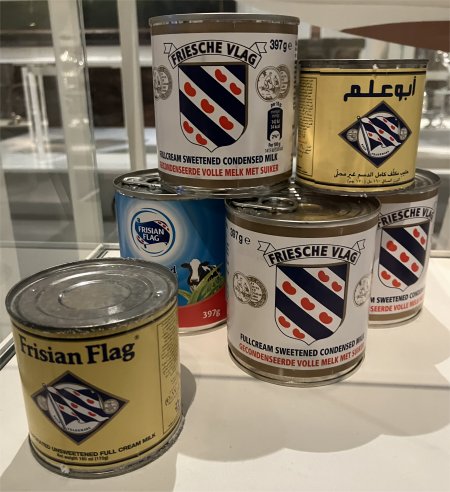 Frisian Flag Tins |
Like the 18th-century draughtsmen Wilschut records changes in the landscape. In his photograph of Stavoren, for example, he does not show the famous statue of the Lady of Stavoren, but a burnt-down hotel. The company wants to expand to the vacant land shown in the photo in front of and behind the building. Meanwhile, in the background are houses built in a style typical of this tourist city.
The other exhibition featured sculptures by Éric Van Hove, who was born in 1975 in Guelma (Algeria). He grew up in Cameroon as the son of engineers involved in development projects. When he was 14, the family returned to Belgium. After his studies at the art academy in Brussels he went to Japan, where he obtained his Master's and PHD. After that he briefly lived in Belgium before moving to Marrakech more permanently. In 2014 he made his international breakthrough thanks to his participation in the Marrakech Biennale.
It was during his stay in Morocco that he began to take a deep interest in all manner of engines. The Mercedes-240 is mostly used as a taxi in Morocco, where its German origin and reputation for quality and indestructibility have made the vehicle a status symbol. The Moroccan's ability to cannibalise old taxis in order to keep existing ones going fascinated him. Indeed it is said that some taxis have done several million miles due to such recycling of engine parts. Van Hove built his Dorigin entirely from Mercedes-240 parts and drove it to its country of origin, where the car is seen more as Moroccan than as a typical German product. In this way, the work of art poses questions about identity and ownership.
For the artist, the engine symbolises industrialisation, which in many countries marked the end of traditional craftsmanship. Production line work has replaced handcrafts. With his impressive replicas, Van Hove puts traditional crafts back on the map. He combines the beauty of design with current themes such as the distribution of wealth and the disparities between the West and the rest of the world.
Glossy wood, shiny copper, polished mother of pearl: materials from all over the world are combined in the traditionally reproduced engines of Éric Van Hove. From the smallest screw to the cylinder head: international craftsmen handcraft each part under the direction of Van Hove.
The highlight of the exhibition is the D9T, a reproduction of a Caterpillar D9 bulldozer engine. Initially this vehicle was designed for construction projects in developing countries. Since the Vietnam War, this bulldozer has often been used by regimes to suppress uprisings and riots and as barricades. Because of this, the bulldozer has come to symbolise oppression instead of construction. Van Hove's reproduction consists of 295 parts, made from 46 materials by 41 different craftsmen. The artwork consists of engraved cedar wood from the Atlas Mountains, carved purpleheart wood from Brazil, wenge wood from Congo and tatajuba wood from Suriname, as well as materials such as polished mother of pearl, bones, ceramics, marble, copper and tin.
One area of the museum that always intrigues me was the section that focussed on Hindeloopen, a small town that we had visited several times. Why was this? The stubborn Frisian town of Hindeloopen used to be a real metropolis. However, Friesland was less appealing to the inhabitants of this town than the rest of the world. On their trading trips Hinderloopers brought Dutch furniture from Amsterdam, fabrics from India and porcelain from China. This created a typical Hindelooper style that combined authentic Dutch and exotic elements. In the 17th and 18th centuries the Hindelooper sea captains retuned home with goods from all over the world. Through these many influences Hindeloopen looked very different from the rest of Friesland. Women wore colourful fabrics from India, Asian porcelain decorated living rooms, and richly decorated wooden furniture was widely used. Trade collapsed in the late 18th century and Hindeloopen became isolated. The population concentrated more on fishing rather than on commerce and the flow of foreign influences ceased. The hodgepodge of Dutch and exotic home interiors and clothing survived and came to be known as 'typically Hindeloopen'.
Already in the 19th century people were aware of the special Hindelooper style. The colourful Hindelooper Room in this section had captured the hearts of visitors to the 1878 World Exhibition in Paris. It was a characteristic Hindelooper interior that came to be known as 'typically Dutch'. After the World Expo, the chamber, which could be dismantled into several components, travelled all over the world. Artists today are still influenced by the Hindeloopen style. Fashion designers Victor and Rolf have made dresses inspired by this idiosyncratic style, and it inspired a collaboration between Christien Meindertsma and the Roosje Oud Hindelooper Kunst 1894 Foundation that produced new furniture in the Hindelooper tradition. I must admit I had gained a far wider appreciation of Hindeloopen through this section than I had gained in the actual town.
I then gravitated towards the Fries Verzetsmuseum (Fries Resistance Museum) section of the museum on the second floor. This gave an introduction to the people who lived here during the Second World War. Frisians and non-Frisians alike related how they survived the war in the Frisian countryside: resistance and persecution, but no winters of starvation, and encounters with refugees and others who came from far and wide to fetch milk and food. Personal stories and authentic objects gave room for thoughts. Special attention was paid to the raid (De Overval) on the prison "Huis van Bewaring" in Leeuwarden in 1944, the most spectacular act of resistance in Friesland during the war. I found this section quite moving. I was particularly taken by a painting titled "The Imagination", made from a photograph of Goffe Hoogsteen, the last remaining liberator of the Blokhuispoort. The artist, Aafje Terlaak Poot, wanted to keep the story of the raid alive.
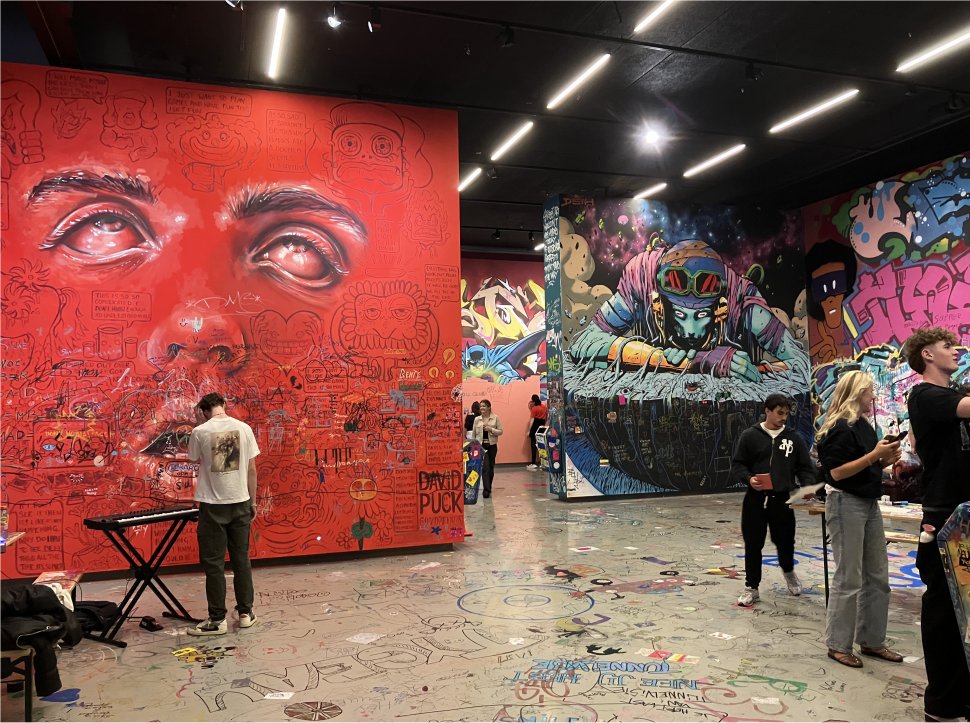 "The Wall is Yours", a Free Space for Graffiti and Street Artists |
The third floor contained contemporary art. One room displayed a collection from several artists, called "Beyond the Horizon", giving their meaning to the landscape around us. Another large room, contained tiers of seats, from which an installation by Tina Farifteh could be watched. It featured a 24-hour trip in 24 minutes along the Frisian Seedyk, titled "When I Saw the Sun and the Moon at the Same Time". The rest of the floor contained paintings by Robert Zandvliet, apparently one of the most important contemporary painters in the Netherlands. His work did nothing for me nor Rex.
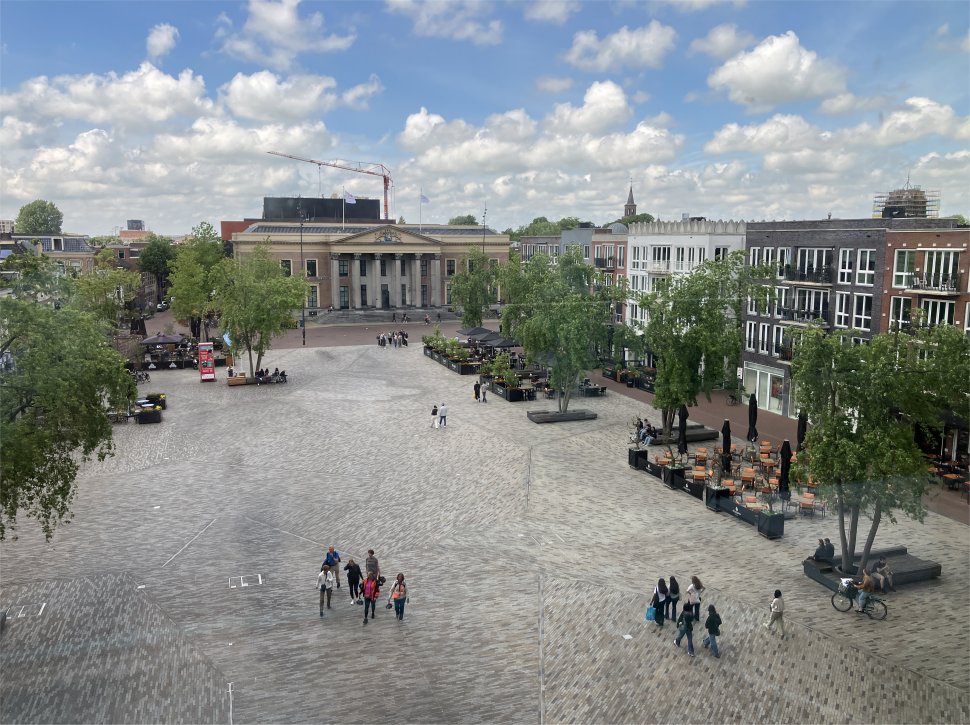 Wilheminaplein from the Fries Museum |
 Leeuwarden Station |
We were given a warm welcome, as always (they know us by now), and were allocated a table downstairs (that please Rex since the stairs are steep and narrow), in a corner (which pleased Rex even more since he felt he was now in command of the restaurant).
The woman who had been running the place for many years was still there, with a new array of young waitresses with ready smiles and perfect command of the English language. Indeed the young woman who served us was Australian by birth.
As always the food was excellent; Rex raved over his mullet and I thoroughly enjoyed my chicken with corn. After a most enjoyable evening, apart from my credit card refusing to work, we headed back to Duonita before the rains arrived. The rains did arrive, just as Rex discovered he could not find his phone. After much huffing and puffing I called his number so that either we'd hear it on the boat, the restaurant will answer it, or a kind stranger in the street would pick it off the ground and answer it. The phone was at the restaurant. Rex trudged off in the rain and sheepishly collected his phone to the amusement of the waitresses. He consoled himself with a brisk march back in yet more rain.