
 One of Many Plaques |
After a hearty breakfast we ambled off to Albert Hijn for fresh food supplies, then Rex took the shopping back to Duonita, while I ventured out on a hike. It gave me time to think about Friesland, a province that has grown on us, and we were determined to revisit this year.
From north-east to south-west Friesland there are many small and large lakes, which are connected to each other by way of canals, waterways and rivers. The total water area is more than 11,000 ha and it is all on the same level. So you can sail without going through locks or sluices. Friesland is not just a land of lakes and water and extensive meadows. In Gaasterland, between Mirnserklif and Wijckel, there is a large forest area with footpaths and openings onto meadows and fields. Traditional farms pepper the landscape, with their shiny black or terracotta red roof tiles, and fields often contain characteristic Frisian pedigree cattle or the elegant black Frisian horses. All of this, plus the most historic villages and towns, rendered Friesland a must visit region.
 Havenmantsje |
Heading down towards the Dok, I passed over the bridge at the start of the Zuiderhaven, and came across the Havenmantsje, a restaurant in a former courthouse which was built in 1884 on the site where formerly the Leeuwenburg, a building of the Frisian Admiralty stood. The name 't Havenmantsje is probably derived from a mechanism of a male who hit the outside of a clock with a hammer. "Mantje" is the Frisian diminutive of "man". The design of 't Havenmantsje is by architect W.C. Metzelaar (1884-1918) who was Reich Architect for Justice. The clock on top of the building dates from 1562 and originates from the Port Gate of Harlingen, which was demolished in 1883. After its stint as a courthouse, the building housed various administrative functions before becoming a restaurant in September 2012.
 Tall Ships in the Dok |
I was soon walking along the Dok, soaking up the atmosphere of a string of tall ships. The last ship in the line was the replica of the ship sailed by Willem Barentsz, De Witte Swaen, or The White Swan. In 2017 Rex and I came across the replica being built in a nearby shelter, following as closely as possible the construction methods of the late 16th century. We continued to monitor progress of the work on subsequent trips to Harlingen. The construction was being carried out by a group of enthusiastic old men, using mainly Danish oak. There were no designs, so the men evolved a design through what they could glean from old paintings and drawings, remains of old vessels deliberately sunk when the polders were being created, a section of the original old ship discovered by Russia and currently on display in a Russian museum, and the Batavia at Lelystad. The story behind the ship is one of the most heroic in Dutch maritime history, inspired by ingenuity, boundless courage and almost superhuman perseverance.
 De Witte Swaen, or The White Swan |
Willem Barentsz was born on the island of Terschelling off the Friesland coast of the Netherlands. He became the pupil of Petrus Plancius (Peter Platevoet), a theologian-cartographer whose sermons are often said to have been lessons in geography and astronomy.
In the late 16th century, the Dutch had an interest in the Orient, though at the time it seemed dangerous to contest the Portuguese monopoly of the route around the Cape of Good Hope. In 1595 Amsterdam merchants, undiscouraged by the English failure to find a Northeast Passage 40 years earlier, decided to resume the search. The Town Council of Amsterdam purchased and outfitted two small ships, captained by Jan Rijp and Jacob van Heemskerk, to search for the elusive channel under the command of Barentsz.
The ships departed on May 18th, 1596, and about three weeks later discovered Bear Island, south of the then-unknown Spitsbergen; they so named the island because of an encounter with a polar bear whose hide did not prove vulnerable to Dutch blunderbusses. Pressing northward, the Dutch ships came across the previously undiscovered uninhabited Spitsbergen islands on June 17th. During the rest of June the Dutch explored the western coast of the main island, thinking it a part of Greenland.
The ships returned to Bear Island on 1st July. Here, anxieties over possible entrapment by ice resulted in a disagreement between Barentsz and Van Heemskerk on one side and Rijp on the other. They agreed to part ways, with Barentsz continuing northeast, while Rijp headed due north to resume exploration of Spitsbergen. Barentsz reached Novaya Zemlya on 17th July, previously discovered but not explored to its northern limit. Barentsz and Heemskerck rounded the northernmost point, naming it Hook of Desire, and sailed eastward, at first believing, from the open water encountered, that they had discovered the Northeast Passage. By November, however, the ice had grown thick and it finally imprisoned the ship. Barentsz and Heemskerck were 81°N at their highest latitude, beyond any point previously reached. Still close to Novaya Zemlya, they realised that they must build a solid shelter ashore in order to survive. They made one of logs and driftwood and moved into this 7.8x5.5m "Safe House" in October.
Dealing with extreme cold, the crew realised that their socks would burn before their feet could even feel the warmth of a fire, and took to sleeping with warmed stones and cannonballs. In addition, they used the merchant fabrics aboard the ship to make additional blankets and clothing. The ship bore salted beef, butter, cheese, bread, barley, peas, beans, groats, flour, oil, vinegar, mustard, salt, beer, wine, brandy, hardtack, smoked bacon, ham and fish. Much of the beer froze, bursting the casks. Proving successful at hunting, the group caught 26 Arctic foxes in primitive traps, as well as killing a number of polar bears. By 8th November, Gerrit de Veer, the ships carpenter who kept a diary, reported a shortage of beer and bread, with wine being rationed four days later. In January 1597, De Veer became the first person to witness and record the atmospheric anomaly known as the Novaya Zemlya effect.
Conditions then deteriorated; the firewood gave out, and the ship was crushed by ice. The men began to construct two small boats. Scurvy had been present for months, and one of the worst sufferers was Barentsz. He left on 13th June with the rest as they slowly worked down Novaya Zemlya, but he grew so weak that he could take no part in manipulating the craft. Barentsz died at sea on 20th June 1597, soon after asking Gerrit de Veer, chronicler of the expedition, to lift him up for a final look at Novaya Zemlya. Heemskerck and the other survivors reached the Kola Peninsula after seven more weeks, where they were rescued by a Russian merchant vessel, and by that time only 12 crewmen remained. They heard of a Dutch ship not far off, and a messenger was sent to ascertain whether it would rescue them. By pure coincidence the Dutch vessel was captained by Rijp, who had returned to Holland and come back for trade. Ultimately, they did not reach Amsterdam until 1st November.
In the 1870s European ships visited "Safe House" and found it partially caved in by snow. Objects left there by the Dutch explorers are in the Rijksmuseum in Amsterdam.
It was heart warming to see this ship now fully kitted out and floating proudly in the Dok.
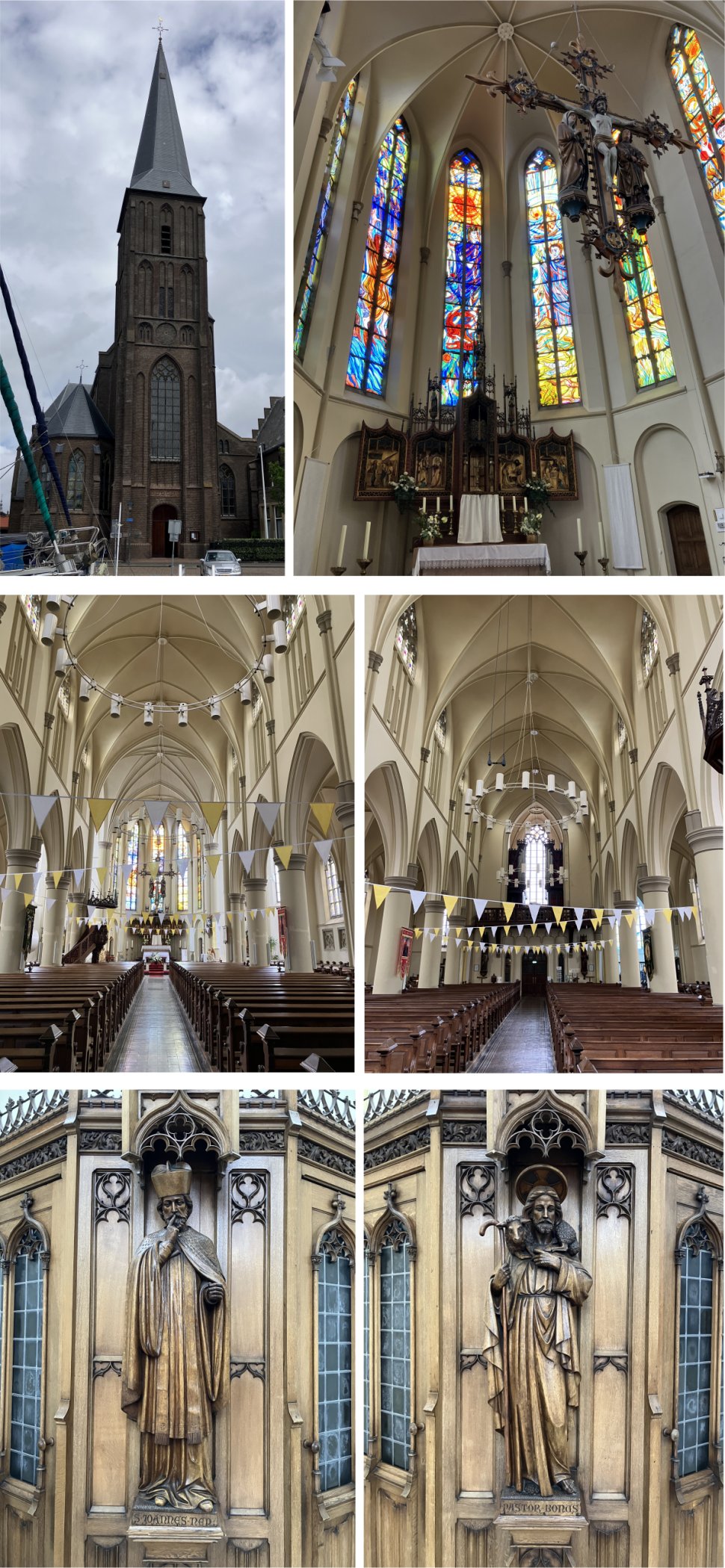 Sint Michaelkerk (St Michael's Church) |
Once I'd had my fill of tall ships, I took a stroll along Zuiderhaven to Sint Michaelkerk (St Michael's Church). For three centuries Harlingen Catholics had struggled in a shelter close to a narrow alley near the church. Then, in 1879, with the approval of the then Archbishop of Utrecht, it was decided to build a new church and parsonage. The construction of this church was completed in 1881, and it was dedicated ceremonially on May 31st. The architect was Alfred Tepe from Utrecht, who also built the Roman Catholic church of Workum. Contractor company Joh.K.Kalt from Ureterp built the church in the place of the old shelter church between the Zuiderhaven and the Schritsen, in the direction north-south (other than the traditional east-west line).
During the Second World War, the tower was hit by an English fire bomb. Later on November 5th, 1941, church and sacristy on the north side were badly damaged by a bomb attack. After the war the choice was demolition or restoration? The choice was simple, and monumental character and characteristic construction were chosen for restoration. In the period 1985-1999 a great restoration took place. The church is now a national monument. The pulpit, the high altar and the side altars come from the studio of sculptor Friedrich Wilhelm Mengelberg. The acrylic glass windows are made by Jan Murk de Vries, and the organ of 1898 was built by Adema.
Inside, I had the whole church to myself. It was the essence of peace; very airy and colourful light danced within due to sunlight streaming in through the many brightly coloured stained-glass windows. I sat for a while soaking it all up.
 Hotze Schuil played kaatsen from 1942 to 1972. He is regarded as one of the best kaatsen players in Europe |
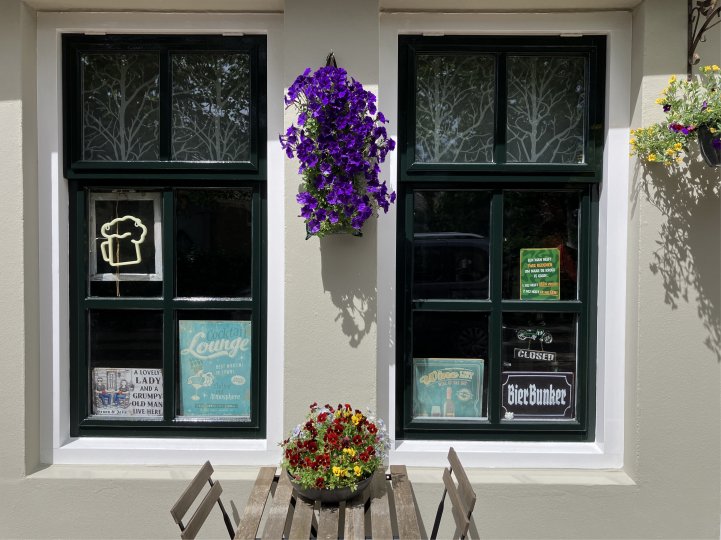 An Anonymous Bar |
 Grote Kerk |
This beautiful church stood proudly today in the sunlight, surrounded by manicured grass. But sadly I could not enter. The church seemed to be reserved for concerts and special functions, some of which were advertised for July - September.
Disappointed, I took a long hike through suburbs up towards the Van Harinxmakanaal, and then turned to head back to HSWV in a long sweeping arc.
 Duonita in HSWV Marina |
Rex was there waiting, in good form. I related my adventure, and then we made a rough and ready plan for a trip to Terschelling the following day, and the day after we would leave for Hindeloopen.
 All Roads Lead to De Lichtboei |
Later we visited De Lichtboei, an old haunt we got to know well when we were ensconced here for two weeks after Rex injured his back. It was cheering to visit that cosy bar again. The large landlady was there as usual (we christened her Big Helga), not the woman to argue with. She said she recognised us from our earlier trips. A motley collection of middle-aged men was gathered around the bar or smoking outside. They are always a friendly bunch, willing to have a chat. A fellow and woman were playing the Dutch version of billiards on a Carom billiards table, also called French billiards and sometimes carambole billiards. Carom billiards played on a cloth-covered, pocketless table. In its simplest form, the object of the game is to score points or "counts" by caroming one's own cue ball off both the opponent's cue ball and the object ball on a single shot. The invention as well as the exact date of origin of carom billiards is somewhat obscure but is thought to be traceable to 18th-century France. A chap I was talking to told me that De Lichtboei team participate in a local league.
 Carom Billiards Table in De Lichtboei |
Later we ambled down Noorderhaven, passing the Stadhuis, and naturally ended up in the Nooitgedagt where we enjoyed another splendid meal.
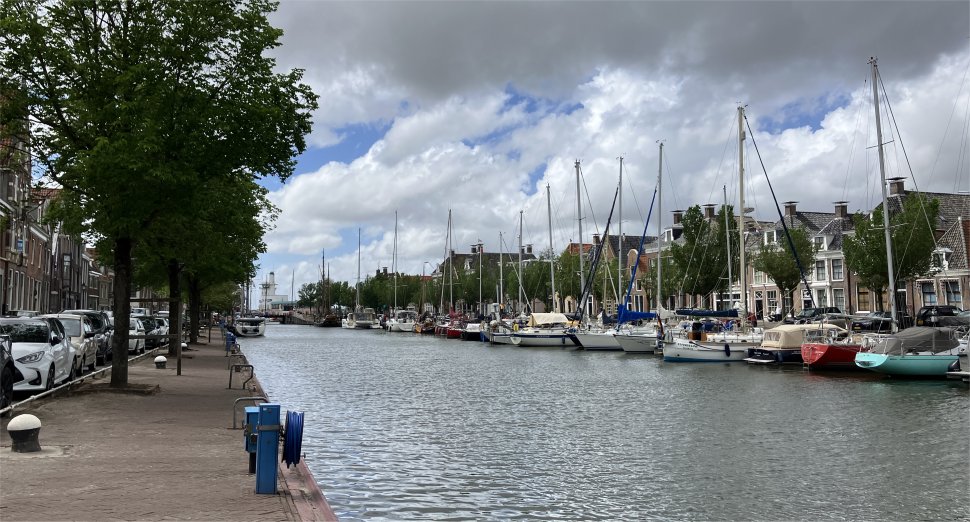 Noorderhaven |
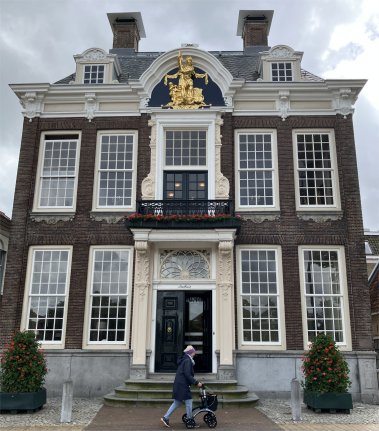 Stadhuis |
 Inside Nooitgedagt |