
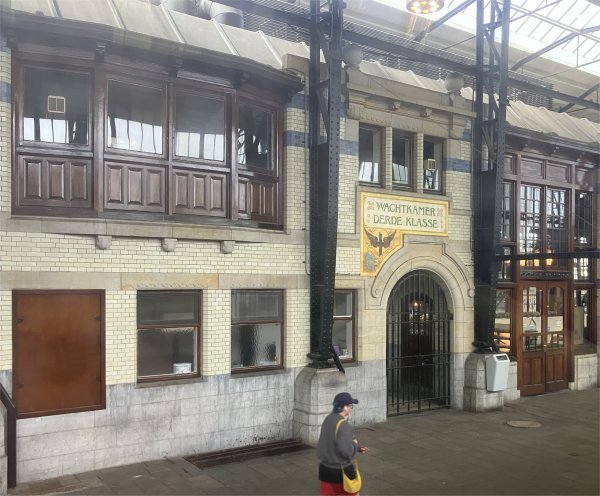
 Third Class Waiting Room in Haarlem Station |
We made our way to Centraal Station and caught the 11:06 train for Delft Campus. Soon we were hurtling through vast stretches of agricultural land, criss-crossed by a myriad of drainage channels. A few farms specialised in flowers, while others had herds of dairy cattle.
The train stopped at Haarlem, where I observed a sign for the 3rd Class waiting room. How times have changed. 27 minutes after we departed from Amsterdam we arrived at Leiden. We alighted at the Centraal Station, a modern building with massive cycle parks outside it. Rex, Meryl and I had visited this university city in 2015. Fortunately the tourist information office was close outside, and in next to no time we were inside buying a guide to the Leiden Loop, a self-walking guide of the city.
"How would you like to pay, cash or card?" asked the attendant, a stocky, middle-aged fellow with a ready smile.
"With grains of salt, please," I replied. The chap looked bemused, Rex rolled his eyes, and I could sense him thinking why does he always do this?
"That goes back to Roman times," I explained. "A popular belief says Roman soldiers received direct sacks of salt as pay, but they were actually paid in standard coin currency (stipendia) with a monetary allowance meant for purchasing salt and vital rations. Payment in grains of salt relates to the Latin word salarium, the origin of our word 'salary'."
The penny dropped, and he laughed out loud. He responded with," I'm always looking for stories," and he proceeded to relate one of his own.
"There was once a man in Leiden who owned a bar. However, he was not keen on administration. His policy was to put a needle into a box for each drink a customer purchased. Then, when the customer was leaving, he paid up for the number of needles he had accumulated. Indeed a pub was eventually named after him: Spiker." We all laughed, then wishing the man well, we departed, and stopped off at a coffee shop where we could chill out and study the walking guide.
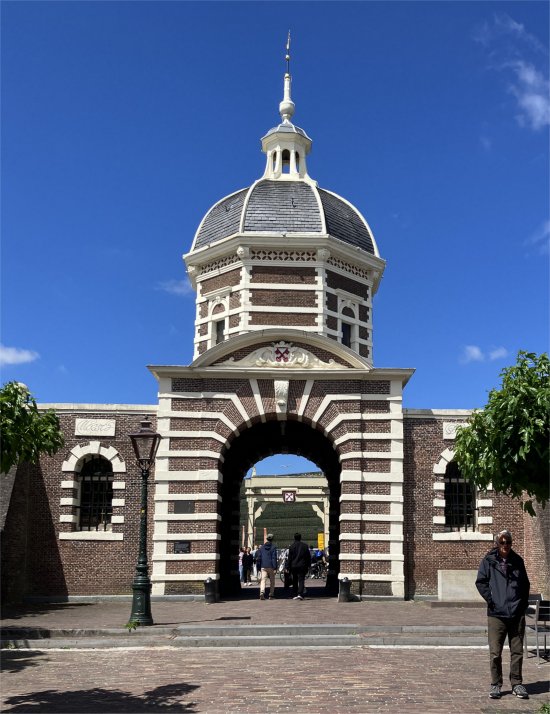 Morspoort |
Leiden is the city where Rembrandt van Rijn first saw the light of day in 1606. It was here that he spent the first 25 years of his life and laid the foundation for his impressive artistic career. Leiden is also the city of the Pilgrims, who were able to live and work here in freedom from 1609 to 1620. They lived in one of Leiden's 35 hofjes (almshouses). Both John Robinson, the leader of the Pilgrims, and Rembrandt could be found at Leiden University in 1620. The Pilgrims, the first settlers of New Amsterdam, nowadays New York, departed by ship to the New World in 1620.
Once we had our bearings we began our expedition. Our first port of call was the Beestenmarkt. During the Eighty Years' War, Leiden was besieged twice between late October 1573 and 3rd October 1574. The city was slowly surrounded by the Spaniards, but the citizens held fast until William of Orange flooded the lands around Leiden, driving the Spaniards from their fortifications. On 3rd October, the Geuzen fleet was able to sail into the city, marking the relief of Leiden. After its liberation, the city experienced unprecedented growth and prosperity, resulting in it becoming the largest city in the Republic after Amsterdam. This triangular square was set up to serve as a livestock market in 1616. Livestock was sold through "handjeklap"; the buyer and seller slapped each other's hands with each bid until a handshake sealed the deal, then the deal was toasted with a glass of Dutch gin.
We pressed on to the impressive looking Morspoort (Marsh Gate). At one time Leiden had ten city gates, two of which were still standing, the rest demolished in the 19th century when the city was extended. The Morspoort was at one time called the Gallows Gate, as it led to the Gallows Field along the Rhine, where the corpses of executed criminals were put on display. The octagonal dome once served as a prison.
 "De Put" Windmill |
 Rembrandt Statue by "De Put" |
Crossing the ubiquitous white lifting bridge by the "De Put" windmill, we entered Rembrandtplein. Rembrandt van Rijn (1606-1669) was born in the Weddesteeg where we stood, and he lived here until 1631. The lane stretched from the edge of the city wall to the Rhine. His family owned several mills on the city wall. He was trained as an artist in Leiden where he produced his first masterpiece. The house where he was born was demolished at the beginning of the 20th century to allow the extension of a printing business, but a plaque set into a wall commemorates this famous artist.
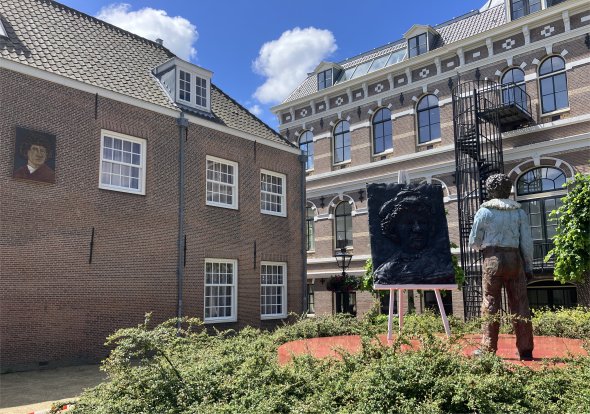 Rembrandtplein |
 Doelenpoort |
We continued south until we hit the Groenhazengracht (Canal of the Green Hare), where we turned left and followed it. This canal was where the local red light district could be found in the 17th century; apparently a brothel owner who lived here in the 15th century was nicknamed "The Green Hare". The Doelenpoort (Doelen City Gate) was located along this canal. This gate led to the training ground used by the two civic guards in Leiden. The civic guard was made up of armed citizens who defended the city in times of war, and played an important part in maintaining public order. The sandstone gate was designed in 1645 by city architect Arent van's Gravesande, and is crowned with a sculpture of St. George slaying the dragon.
The Rapenburg that we walked down became the city's most prestigious canal. It was dug around 1200 to defend the young city of Leiden. During the 17th century, it became a place where rich merchants built their houses, and professors, printers, and governors had imposing canal homes built.
 Bibliotheca Thysiana |
One of the impressive buildings on the Rapenburg was the Bibliotheca Thysiana. Johannes Thysius (1622-1653) was a lawyer and alumnus of Leiden University, who bequeathed his collection of books to the university upon his death. His will required the construction of a special library for his collection. It is the only 17th century library to have survived intact to this day in the Netherlands.
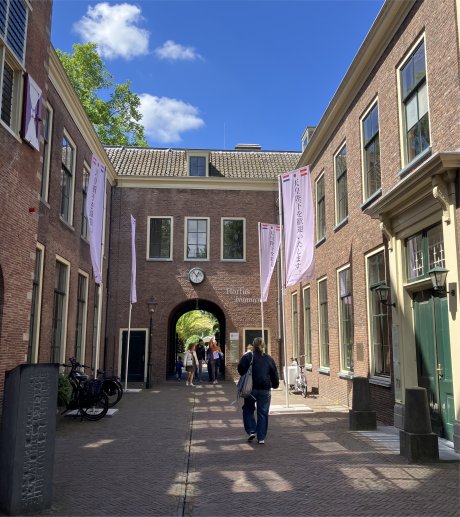 Academiegebouw (Academy Building) |
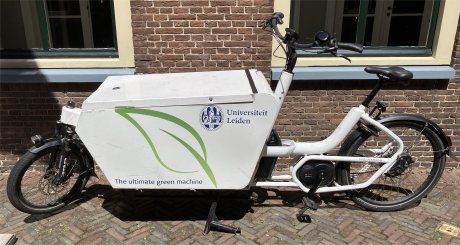 Green Machine |
 Hortus Botanicus |
Right next to the Academiegebouw was the Hortus Botanicus. A botanical garden was established behind the Academiegebouw shortly after the founding of the university. Carolus Clusius, curator of the botanical garden in Vienna, designed the layout and planted the first tulips in Western Europe. A wisteria behind the entrance gate was planted by Clusius.
We noticed many banners and display boards were spread about the city, all displaying Chinese/Japanese text. Perhaps there was an international conference or a twinning society in action.
Moving on, we crossed the Nonnenbrug. The sun was now making its presence felt, and we needed a break so we settled ourselves down for BLT sandwiches at Café Barrera just over the bridge; a most welcome refreshment.
 Entrance into the Vliet Canal |
The most southerly point on our walk was the Van der Werf Park, a quiet, green oasis in the bustling city. The park was created out of a catastrophe. On 12th January 1807, a ship loaded with 17,760km of gunpowder exploded at the Steenschuur, the street on the other side of the canal, destroying an entire residential district. Some 160 people were killed and 2000 injured. Buildings all over the city were damaged. Nothing was rebuilt for a long time. In 1884 a statue of Mayor Van der Werf was erected on the so-called Great Ruin, surrounded by a park. Van der Werf was regarded as one of the heroes of the Spanish siege of Leiden in 1574.
 Kamerlingh Onnes Building |
Across from the park stood the Kamerlingh Onnes Building. Half a century after the explosion, a laboratory was built in this place. It rapidly became one of the most advanced laboratories in Europe, where renowned scientists such as Marie Currie (1867-1934) and Albert Einstein conducted their research.
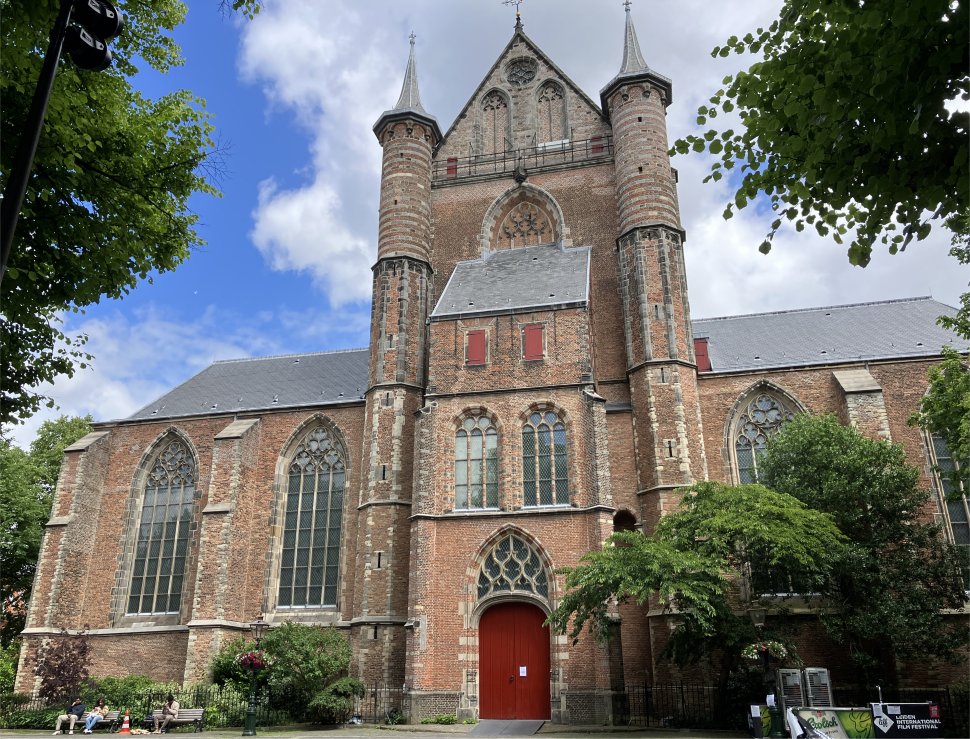 Pieterskerk |
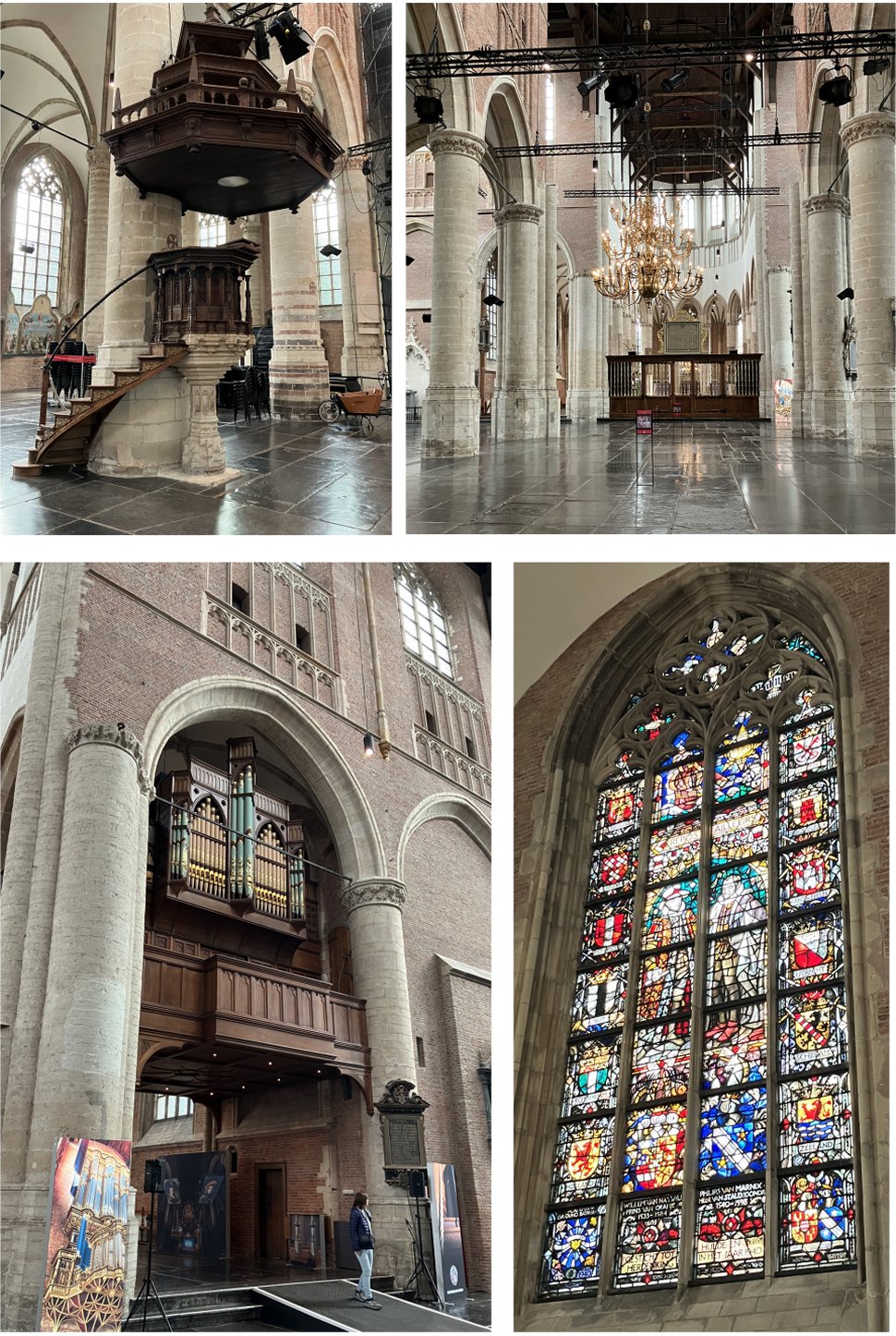 Interior of Pieterskerk including the Marnix-Window |
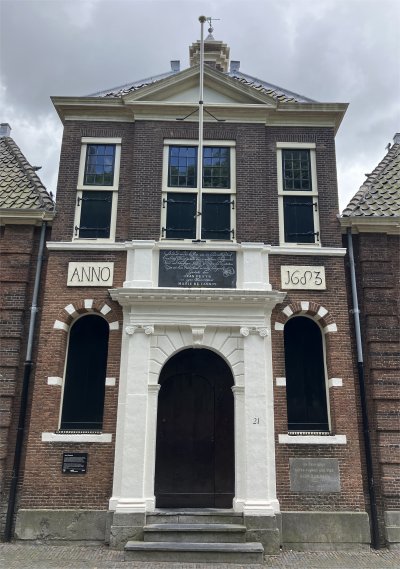 Jean Pesynhof Almshouse |
 Plaque Dedicated to John Robinson by the Jean Pesynhof Almshouse |
Time was marching on. Near the front of Pieterskerk was the Gravensteen, dating from the start of the 13th century, originally the prison of the Counts of Holland. In 1463 the building was transferred to the city of Leiden, and served as a city prison. From the gallery to the front of the tower, sheriffs and magistrates had a good view of the execution site, popularly known as "pure sorrow" or "the green turf".
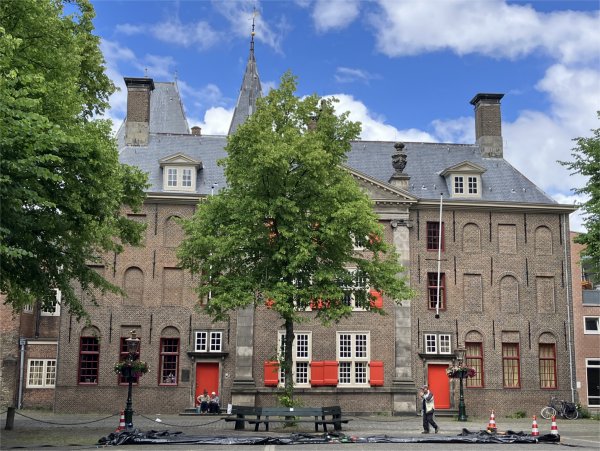 Gravensteen |
 Latin School |
On Lokhorststraat, we came across the Latin School, built in 1599. Up to the start of the 17th century, the Latin Schools were considered higher education, as were universities. The Latin School prepared students for university. Rembrandt attended school here from 1613 to 1620, from age 7 to 14. All lessons were taught in Latin, and exams were held in this classic language too.
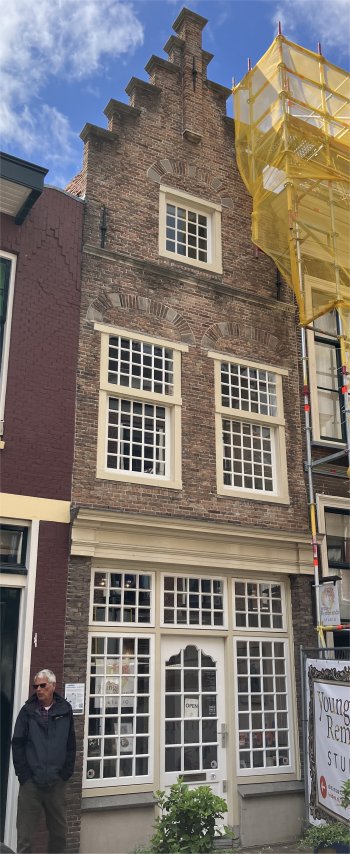 Young Rembrandt Studio |
On our hike it became apparent many groups of young women were out enjoying impromptu food and drink gatherings outside. Perhaps they had all finished their exams and were celebrating. Other groups of girls were celebrating on canal boat tours.
A shimmy to the right brought us down to the Young Rembrandt Studio. Jacob Isaacszoon van Swanenburg was Rembrandt's first teacher. Rembrandt was 14-17 tears old during that time. Van Swanenburg was trained by his own father, Isaac Claesz van Swanenburg. He travelled to Italy in 1591 in order to work there, returning to Leiden in 1615. The building standing before us was his home and workshop where he also received his students. Van Swanenburg passed away in 1638 at the age of 67, and was buried in the Pieterskerk.
Heading east we came across the Stadhuis, a proud example of a 17th century building. On a cold night in January 1929, this town hall went up in flames. Only the facade was saved. In Rembrandt's time, it was practically a museum, with a wealth of artworks and masterpieces on display.
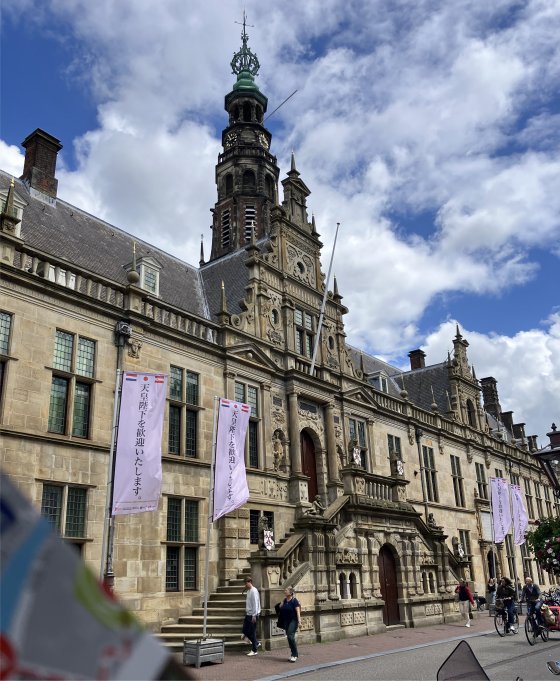 Stadhuis |
Near the Stadhuis, crossing the Nieuwe Rijn, lay the Koornbrug (Corn Bridge), the place where grain was traded for many centuries. In 1834 a roof was built over the bridge to keep the merchandise dry. Corn was stored under the roof, with holes in the ceiling for ventilation. Leiden does not have a central market square.
 Market on the Koornbrug |
 View of Nieuwe Rijn from the Koornbrug |
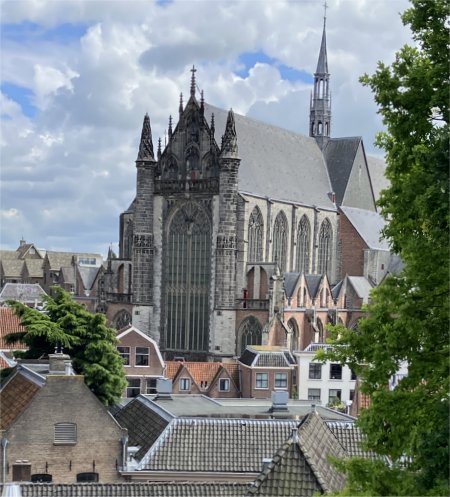 Hooglandse Kerk from the Burcht |
We crossed the bridge and visited the Burcht. This Citadel is unique in Holland and is an example of a motte castle. The man-made hill dates from the 9th century, and was topped by a wooden palisade. The Citadel offered protection against the rising water of the Rhine, against any attackers. But, as the city expanded rapidly around the Citadel, it was no longer possible to provide protection against invading enemies. From the 17th century the Citadel became a city park. It was well worth scaling the steep steps up to the summit, where I was afforded excellent views of the city from the ramparts.
 Hooglandse Kerk |
Dropping down Nieuwstraat, at the confluence of the Oude Rijn (Old Rhine) and the Nieuwe Rijn (New Rhine), stood the Hooglandse Kerk, founded in 1314 as a wooden chapel, dedicated to St. Pancras. In 1366 construction on a gothic church was started, but the building was never completed. The Hooglandse Church served as water supply to the local citizens. The roofs of the church caught a lot of rain water that was stored in large reservoirs to provide the people around the church with drinking water in times of drought.
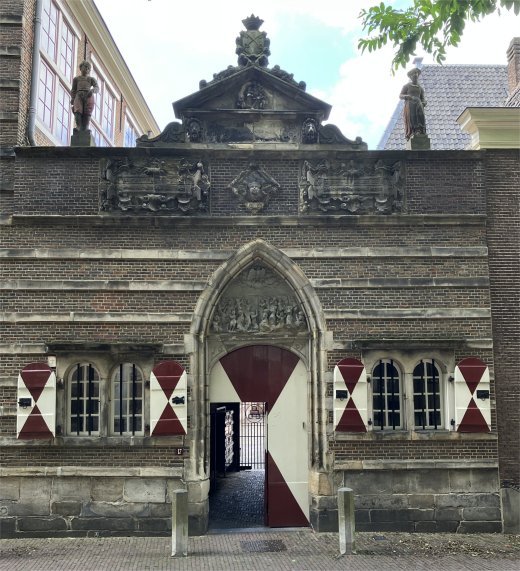 Heilige Geestweeshuis |
We headed in a northerly direction, passing the Heilige Geestweeshuis (Holy Ghost Orphanage) of 1583 on the way. On the gate are an orphan boy and girl. The gate led to a courtyard with the former girls' and boys' wings on either side. The orphanage was extended several times during the 17th and 18th centuries. The orphans came from other cities too, such as Aachen and Liege, to learn a trade. The textile industry made use of them. Older orphan boys often learned a craft, whilst the girls acquired domestic skills. Orphans were still living here up to 1961.
 Waag |
The Waag was our next port of call. Unlike most old Dutch cities, Leiden has no central market place. Goods entered the city on flat-bottomed boats and were hoisted onto the quays where they were sold. It was therefore logical for the Weighing House to be built at the water's edge. In an age when cheating with weights was common practice, the Waag had an important role to play; the weights were officially calibrated here and buyers could be sure they weren't being cheated.
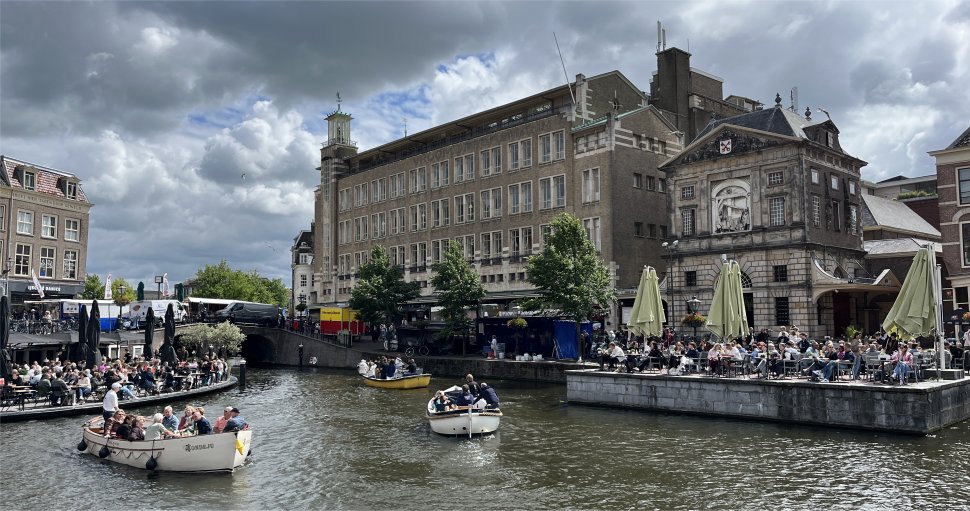 Confluence of the Oude Rijn and Nieuwe Rijn from the Catharinabrug |
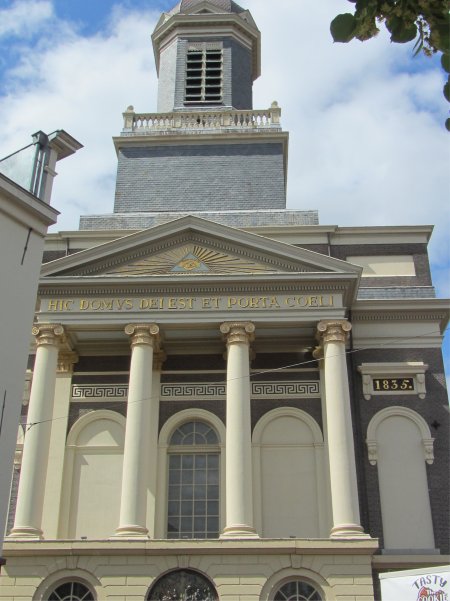 Hartebrugkerk |
Crossing over the Catharinabrug by the Waag, we came to the Hartebrugkerk. In around 1825 church buildings were constructed using state subsidies because the churches themselves were very poor. The state looked for reliable experts who would ensure that the subsidies were used wisely. Engineers from the Water Authority were able to provide this service, and were already spread throughout the Netherlands. This explains why most church buildings from this period were described as "Water Authority style". The poem in gold letters on the front facade of this church said: "Hic Domus Dei est et Porta Coeli" (This is the House of God and the gateway to Heaven). Local people referred to it as the "Koelikerk", from the Latin word "coeli" meaning "heaven".
Not far away was Vrouwenkerkplein, which was already inhabited in the 10th century. Around 1300, a chapel stood here. After the area became part of Leiden, the chapel became the city's third parish church, the Onze-Lieve-Vrouwekerk (Church of Our Lady), in 1364. Following the Reformation in 1572, the church was assigned to the French-speaking Walloon community.
We were flagging now, and stopped for a drink. I discovered the way to summon a drink was not to hope a waiter would pass by, but head inside where a Chinese barman would pour the drinks and bring them out to us. The small drinking area outside contained aging motor cyclists, and a group of middle-aged men who were celebrating the forthcoming marriage of one of their gang.
Saturated in culture, we ambled across to Beestenmarkt, in time to catch the last song being played by an orchestra.
We made our way back to Amsterdam, and took a short stroll, the plan being to find a bar for a couple of beers before settling down in a restaurant. A bar on a corner overlooking a canal found us; strange that. Once we had ordered a beer each, Rex nipped out for a coffin nail, as is customary. A young Dutch fellow strode up to the bar next to me, ordered two beers, and plonked himself into the seat next to me. He turned around, looked at me, and looked through me at the same time. I correctly assumed he was intoxicated. We got chatting; his name was Tom, he wrote software for various companies, he worried about the effects of AI on society. His girlfriend of 13 years worked in primary education, and she was worried that young children in Holland were becomong addicted to social media. He feared for his children and future grandchildren. Hmm ….. that's the same the world all over was my opinion on the matter. When I steered the incoherent conversation to how Holland has become much more expensive over the last year, he totally agreed. Property prices around Amsterdam are typically 5M Euros. Wages have not risen to offset the increase in the cost of living. The same all over Europe was my summing up. He took another swig of beer before he took that on board.
Rex suddenly appeared and got involved in the conversation, and almost simultaneously Tom's friend materialised. He was more sober than Tom, a very lively, confident lad who spoke good English. We learned the two pals, both in their early 30s, knew each other from their school days. Tom lived in Amsterdam whilst his mate lived in Eindhoven. Tom's friend, I never did catch his name, was mad keen on football, and soon he and Rex were in banter mode about the state of Dutch and English football. Rex confused Eindhoven with Middelburg. The lad laughed out loudly. "Middelburg don't even have a team in the leagues," he pronounced. We chatted about Ipswich's climb to the Premier League, and the former Liverpool manager, Arne Slot, who had previously managed the Dutch club Feyenoord. He had left Liverpool recently after a disappointing set of results during his last season. Rex and the lad could have chatted for hours over football; Tom didn't seem to care less about it.
Tom's pal explained he worked as an operations engineer in a food processing plant in Eindhoven. Basically convoys of trucks would arrive at the plant from a large swathe of the country with assortments of farm animals 24x7. The animals would soon meet their ends, and be mechanically stripped of flesh. The lad's job was to keep the production line going non-stop. If any equipment failed, he had to repair it immediately otherwise the convoys of trucks would start blocking up the road systems. No pressure there then.
The duo would not believe us two geriatrics had sailed a boat around Holland. Their redeeming feature was they bought me and Rex a Brouwerij 't IJ each, brewed in a famous organic craft brewery in Amsterdam. We both needed food at this point, and we wanted to return the favour to the lads and buy them a drink each, but they wouldn't have it, they wanted to welcome us to Amsterdam. So we put a round in for them behind the bar, and made our farewells. A good pair of lads.
 Tom's Friend, Rex, Me and Tom |
We returned to Duonita well fed and watered, and we were shattered after all the hiking. But it had been a brilliant day, I would recommend a visit to Leiden to anyone.
|