
 De Beurspassage |
After an unsuccessful attempt at fixing the cord in my tracksuit bottoms, I headed off to the big city of Amsterdam. I needed to buy some presents to take back to my grandchildren. Nowadays I find it difficult choosing suitable gifts.
Rex wanted to stay behind, can't say I blame him, to catch up on his reading and visit the local food shops.
Once at the Centraal Station, I headed south, passing De Beurspassage, a beautiful mall with vivid golden and green paintings, eye-catching chandeliers and mosaic works. It connects the main street to the back small alley. The mall is also home to several restaurants and cafes.
 National Monument |
 Royal Palace |
 Civic Orphanage |
I eventually picked up a main drag with plenty of shops along it. Sadly, these were mainly sports shops and adult clothing stores. In addition, many seemed to open at noon. I suddenly spotted at the end of an ally, just off the drag, what would have been the Civic Orphanage. It was founded in 1578. Before that, the building was a convent, but once the Reformation hit Amsterdam, the city government confiscated the building from the nuns who lived there.
During that period children often became orphans because of the plague or other infectious diseases, and the orphans received schooling and training at the Civic Orphanage. The idea was to bring these poor orphans up in a Christian environment so that they would become good workers as adults. Placing the orphanage in such a central location was intentional: to make sure the people of Amsterdam saw them and how neat and obedient they were, so that the city’s prominent citizens would donate to support the orphanage. The boys learned trades and the girls learned homemaking skills. The orphanage had a good reputation: it was a high-status project, and stayed in operation until 1960.
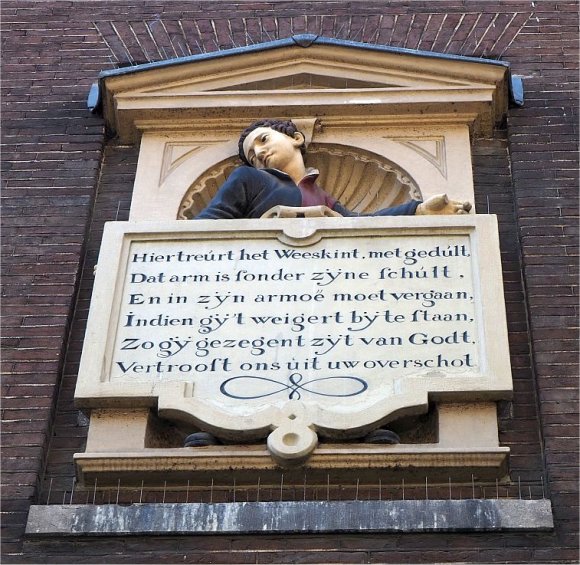 Civic Orphanage Plaque |
Up high on either side of the entrance to the orphanage are two images, each with a verse. One translates as:
Here languishes the orphan, with patience,
Who is poor through no fault of his own,
And in his poverty he must perish,
If you refuse to stand by him,
Thus you who are blessed by God,
Comfort us with your surplus.
 Sunday Art Fair |
I walked for what seemed like miles. However, my hike wasn't wasted, I did stumble across the Sunday's art fair on the Amsterdam Spuiplein. The stalls were occupied by a wide selection of artists, each exhibiting their endless and unexpected possibilities of art in 2D and 3D. Works of art produced by very modern as well as by skilled, traditional techniques were on display; very inspirational work.
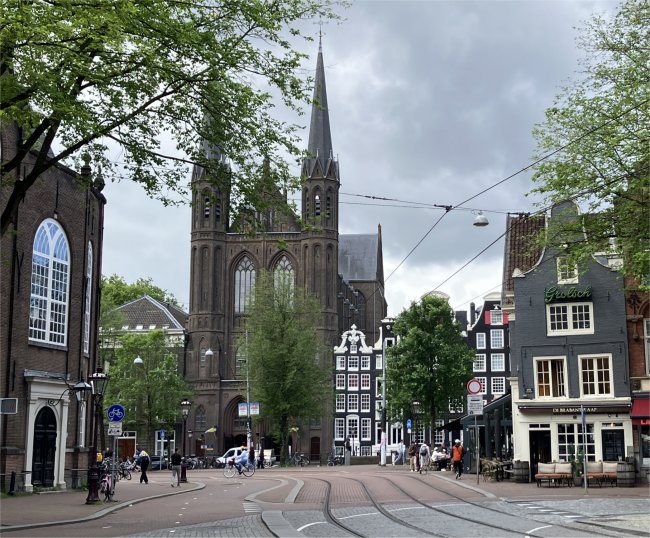 De Krijtberg, Sint Franciscus Xaveriuskerk |
The De Krijtberg, or Sint Franciscus Xaveriuskerk, provided more light relief to the tedium of shopping. The church is dedicated to St Francis Xavier and is one of the rectorates within the Roman Catholic parish of St Nicholas. It is recognised by its two pointed towers. Since 1654 there has been a Jesuit church at this location. The original clandestine church was replaced by another one in 1677. The current Neo-Gothic church was built on the same space in 1881. Space limitations urged architect Alfred Tepe to design an unusually tall church with a monumental front. The interior was provided by members of the Guild of St. Bernulphus, most notable the Mengelberg firm. Most of interior has survived.
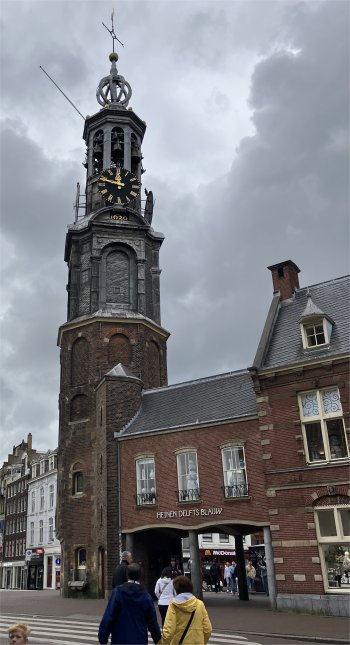 Munttoren |
I broke through into the expanse of the Muntplein, where the Amstel river and the Singel canal meet. Proudly standing guard over this square was the Munttoren.
The tower was originally part of the Regulierspoort, one of the main gates in Amsterdam's medieval city wall. The gate, built in the year 1480, consisted of two towers and a guard house. After the gate went up in flames in a 1618 fire, only the guard house and part of the western tower remained standing. The tower was then rebuilt in Amsterdam Renaissance style in 1620, with an eight-sided top half and elegant open spire designed by Hendrick de Keyser, featuring a clock with four clockfaces and a carillon of bells.
The name of the tower refers to the fact that the guard house on the side of it was used to mint coins in the 17th century. In the Rampjaar ("year of disaster") of 1672, when both England and France declared war on the Dutch Republic and French troops occupied much of the country, silver and gold could no longer be safely transported to Dordrecht and Enkhuizen (where coins were normally minted), so the guard house of the Munttoren was temporarily used to mint coins.
The present guard house is not the original medieval structure but a 19th-century fantasy. The original guard house, which had survived the fire of 1618 relatively unscathed, was replaced with a new building during 1885–1887 in Neo-Renaissance style. The architect was Willem Springer. An underpass between the tower and the building was made during the 1938-1939 renovation.
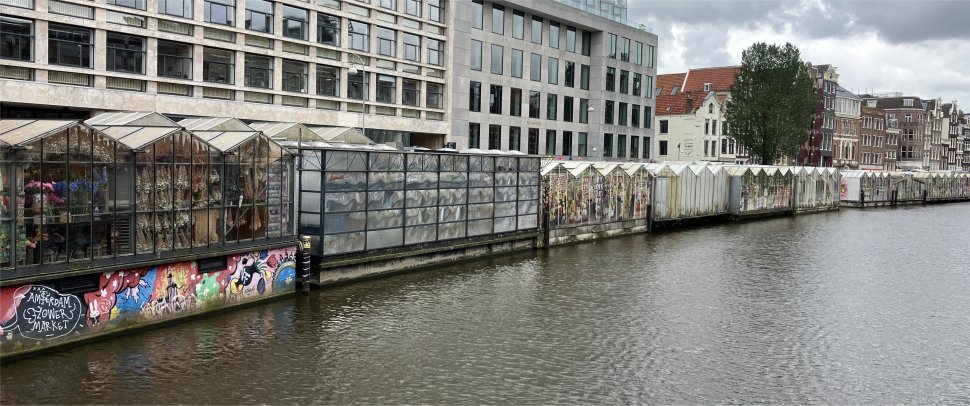 Bloemenmarkt |
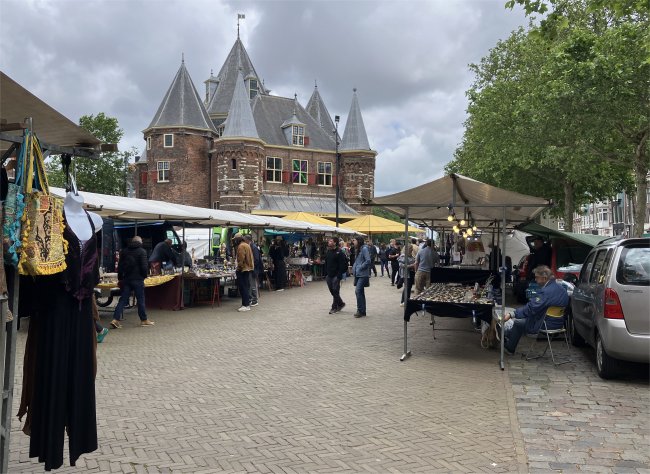 Waag in Nieuwmarkt |
I hadn't a clue where I was in the city by this time, so judicial use of Google maps helped me navigate back to the central city. I called Rex to see if he wanted to meet up, but he was happy to stay on guard on Duonita.
I followed more canals, passing coffee shops with strange, weedy, smells emanating from their smoky depths, and arrived at the Nieuwmarkt, a large, busy square with the imposing Waag squatting in it. Wherever you go in the Netherlands you'll always come across a Waag (weighing house). Of course its own Sunday market was in full swing.
By now I was feeling peckish, so I partook in a 'build your own wok' meal. I chose rice, chicken, bell peppers, broccoli, ginger, miscellaneous other vegetables and Indonesian hot curry sauce. It was delicious and satisfied my craving for spicy food.
Having had my fix, I headed back to Duonita. In the evening we returned to the Van de Werf. It was less crowed this evening and the food was good again. Our waitress had parents who hailed from Suriname. She was currently on a gap year, intending to start a course at university after the summer, studying Ecomatics. Her explanation was not at all clear, but as far as I understand it the course would cover strategic business consulting and technology development to assist innovation-driven ventures with capital strategy, product building, and go-to-market execution. Wow!
We knew Holland were playing Japan in the FIFA World Cup at 10pm. However, there were no bars around NDSM to watch it, and heading across to the city would have been a chore so late in the evening: we let it go.
The result was a 2:2 draw.