
The island was formed in the Middle Ages from a sandy area called De Schelling in the west and the original island Wexalia in the east. The name Wexalia, Wuxalia, or Wecsile is the medieval name of eastern Terschelling. However, this name disappeared at the end of the Middle Ages. The last appearance of the name Wexalia is in a treaty between Folkerus Reijner Popma, then ruler of Terschelling, with King Edward IV of England in 1482.
The oldest traces of civilisation on Terschelling date from around 850, when a small wooden church was built on a hill near Seerip or Strip. This hill was later used as a burial ground and is known as the "Striperkerkhof".
The Dutch navigator Willem Barentsz, who we came across at the small museum at the port in Harlingen, was born on Terschelling around 1550. Historically, tensions existed between the inhabitants of West-Terschelling, with its strong orientation towards the sea, and the more agriculturally oriented inhabitants of East-Terschelling. In 1612 this led to the division of the island into independent political entities, West-Terschelling and East-Terschelling.
 Vuurtoren Brandaris |
Only after the French occupation at the start of the 19th century, the independent political entities of West-Terschelling and East-Terschelling were once again united as one entity.
We started our adventure on Terschelling by heading up Torenstraat to the Brandaris in the centre of West Terschelling.
Towering above us in the centre of the main square was the Vuurtoren Brandaris. This Terschelling lighthouse is the oldest lighthouse in the Netherlands. In 1323, the town of Kampen (at the head of the Ketelmeer) commissioned the construction of a lighthouse. This was intended to guide sailors between Vlieland and Terschelling, on their route from Kampen via the Zuiderzee (now the IJsselmeer) to the North Sea. This became the first Brandaris. However, the tower was built too close to the sea, and on 22nd January 1593 the tower collapsed.
In February 1593 it was decided that a second Brandaris had to be built, this time inland. This tower also failed in October 1593, when it collapsed during construction, probably through the use of bad stone and sloppy processes. The current tower dates back to 1594. In 1837 the Brandaris became the first Dutch lighthouse with a turning Fresnel lens. In 1917, Philips began to develop a new lamp. This eventually became an enormous light bulb with a diameter of thirty centimetres, the "Brandaris lamp". This was first used on 13th July 1920.
The seven floor tower itself is 53.66 meters high, the light being 55.5 meters high. The light of the tower is visible in a radius of 29 nautical miles; about 54 kilometres.
But the grandeur of this magnificent tower was dwarfed by our need to top up our breakfast; we had only snatched some cereal at 06:10 and the sea journey had made us ravenous. We had to search for somewhere open, but were cheered to grab coffee with scrambled egg on toast garnished with avocado and water cress. It was very tasty, but at almost 34 Euros you'd expect it to be tasty!
 Anchors and Conning Towers |
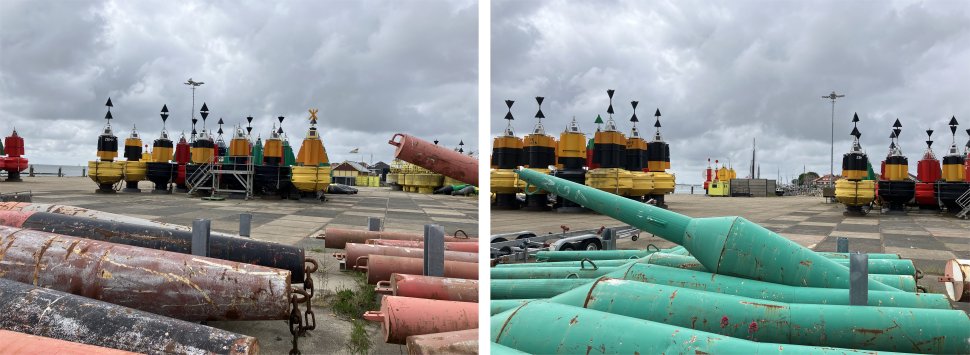 Buoys Everywhere |
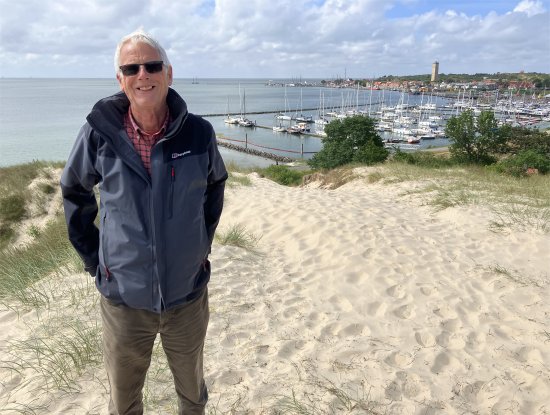 West Terschelling from Hoge Duin Haven West Terschelling, Rex Wrapped up for Winter |
We took a different route down the dune, passing masses of colourful flowers on the way, and walked back along the waterfront. In our amble we took in the flotilla of large rowing boats which took part in an annual race, an event that had been happening since 1975. Rex told me about one of his old work mates who participated in such events back in the UK.
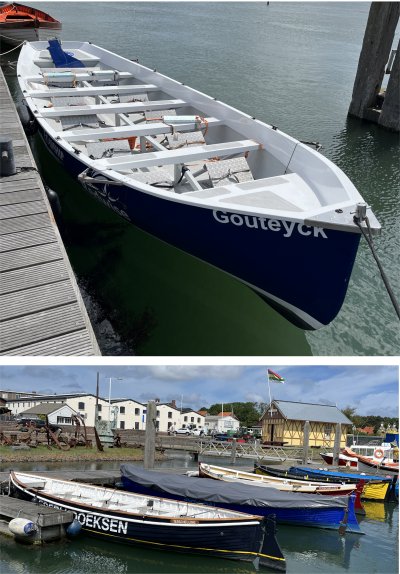 Race Rowing Boats |
Boated out, we continued south, passed the ferry terminal complex, and stopped to climb a low hill. Perched on the top was a monument, the Zeeliedenmonument, with a statue of a woman looking out over the sea. It was a sailor's monument, dedicated to all Terschellingers who are not returned from the sea. A plaque on the front read, "They are not truly dead who live in our heart the Genestet". A Dutch couple kindly took our photos, lots of them. They were a friendly couple who had been married for 50 years, and I guess celebrating that milestone.
 Zeeliedenmonument |
We entered this large, busy premises for coffees plus ham and cheese toasties. A group of twenty somethings took over a large table next to us. They had all hired a large house on the island for intensive partying.
"Where are you from?" enquired one of the lads.
"The east coast of England. I live in Ipswich", I replied.
"Oh, they have a football team," replied one of the other lads. "Do you support it?"
"Yes, …..".
But before I could finish the sentence he interrupted with, "They have car wreckage there too."
After a while I ascertained he and his pal were talking about stock car racing.
"Yes, there is stock car racing and speedway at the Foxhall Stadium," I added.
It soon became apparent that they were real enthusiasts. They dragged another one of the lads into the conversation. This lad's brother actually raced stock cars, while he preferred to fix the cars. He pulled out his phone and showed us some photographs, one showing two cars locked together as they careered around the track.
We enquired if electric cars were ever used nowadays. "Not yet," they said. There is probably good reason for that I thought. I'd hate to think of heavy electric cars colliding resulting in the risk of a severe battery fire.
The Dutch are being enticed to shift from fossil fuels to electric. The Dutch government is actively accelerating the shift to electric vehicles (EVs) by gradually phasing out tax breaks for zero-emission vehicles (ZEVs), scaling subsidies, and introducing a penalty for employers offering fossil-fuel company cars. The broader goal is to mandate all new passenger cars to be zero-emission by 2030.
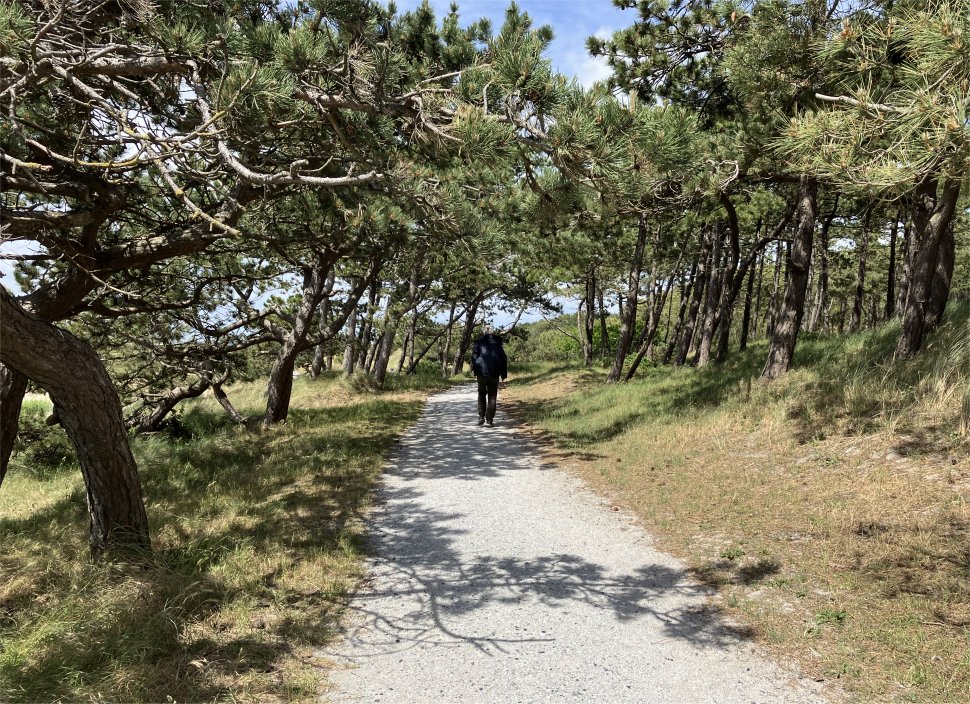 Rex Marching along the Groene Strand Path |
Away along the path, an offshoot led to a set of steps which climbed up to the top of a large dune, Seinpaalduin, where a couple of benches gave us chance to catch our breath.
The 360-degree views from this vantage point were spectacular. To the east we could make out across the Waddenzee a hazy Harlingen on the horizon. Below us was the harbour, busy with craft and ferries. Turning south, Vlieland sat on the horizon. We were last there in 2019. Spinning around clockwise, a long series of high sand dunes faced the North Sea, with a long stretch of forest behind them. Then sweeping down the Waddenzee side of the island, a vast expanse of sandbars and mudflats stretched exposed by the low tide, dotted with tiny figures meandering across the shallows. Brandaris Tower stood prominently below us. The island is approximately 30km long, and roughly 4-4.5km wide at its broadest points.
 View from Seinpaalduin |
My mind flicked to the poem Ozymandias by Percy Bysshe Shelley:
" . . . . . . . . . . . . .
'My name is Ozymandias, king of kings:
Look on my works, ye Mighty, and despair!'
Nothing beside remains. Round the decay
Of that colossal wreck, boundless and bare
The lone and level sands stretch far away."
Stretching the point perhaps, but you get the message.
We followed steps down to the town below, skirting the town to the cemetery and the Brandaris Tower. Then it was a stroll down Torenstraat, calling in at the Koffiehuis 't Wakend Oog overlooking the ferry terminal for a refreshing cool drink. We were killing time waiting for the 16:25 ferry.
The trip back to Harlingen was uneventful, but very, very noisy. It seemed as if there were a couple of dozen Mothers Union meetings taking place simultaneously, all competing with each other to be heard. A chap sitting behind us was screaming into his phone all the way back as he tried to compete with the din. What a delight. We had time to return to Duonita for a refresh and change of clothing, (our ample warm clothing for the cold morning had been overkill for the rest of the day), before heading out for the evening.
 Cheers from Nooitgedagt |
"It's good to see a pub like this thriving and well supported by the community," I said. "Many pubs in England have closed down, partly due to the cost of cheaper alcohol in the supermarkets," I added.
"A lot of pubs are closing in Holland too, the increase in cost of living is predominant," he replied. "This pub keeps going because the landlady is very rich, and she opens it now when she feels like it."
"Do you speak Friesian?" asked Rex.
"No, I refuse to speak it. In Harlingen a separate dialect is spoken, but as you get more out of town, more and more Friesian is spoken."
"Have you always lived in Harlingen?" I enquired.
"No, I came from Amsterdam, but 25 years ago my wife, who was working in Amsterdam, became pregnant, and she wanted to be near her mother, so we moved up here."
"I imagine you must like it up here?" probed Rex.
"Well, it is great for young kids, there are good beaches and it is safe. But when it comes to schools, there is only one secondary school. There is not much choice. Also youngsters have to move away to find work."
We chatted about sailing. He was involved with a group of volunteers who took young people out on tall ships, a rewarding activity. He had an in-depth knowledge of sailing, and we discovered he was a rigger by profession. Sadly, the number of riggers was declining.
"I had to summon the services of a rigger last December, I needed my furling gear to be replaced," chirped up Rex. "I kept calling him, and he kept saying he'd get back to me, and in the end I was almost begging the chap since the boat was due to go back in the water soon. Then, and only then, he did the job."
Richard laughed, "That'd the way they work it, wait until you are desperate, and then you can choose how much to charge." All three of us enjoyed a further beer each after that enlightenment.
But time was pressing, we bade farewell to Richard, and made our way to Nooitgedagt again for our final meal in Harlingen.