
"I once sailed to England, to Lowestoft," he told us. "Have you sailed across to the Baltic?" he asked.
"Yes, in 2011 we sailed to St Petersburg." He was most impressed.
"We took the train to Leeuwarden two days ago, and the ferry to Terschelling yesterday. The skipper needed a rest from navigation for a few days, " said Rex.
The chap laughed, and responded with, "I go to Terschelling most days. I am a captain of one of the car ferries to the island."
We let him go about getting his boat readied. After filling the water tanks, we slipped our lines and headed out into the Van Harinxmakanaal, and followed a large barge laden with school children into a lock that was open.
Once through, we motored through the harbour and joined an armada of tall ships that were jostling for position in the face of a SW wind in order to face the wind and raise their sails. Almost all had young folk providing the brute power. Perhaps Richard, the fellow we had met the previous evening in De Lichtboei, was volunteering on one of these ships. It was magnificent to see these graceful boats slowly hoist their sails and race each other across the Waddenzee.
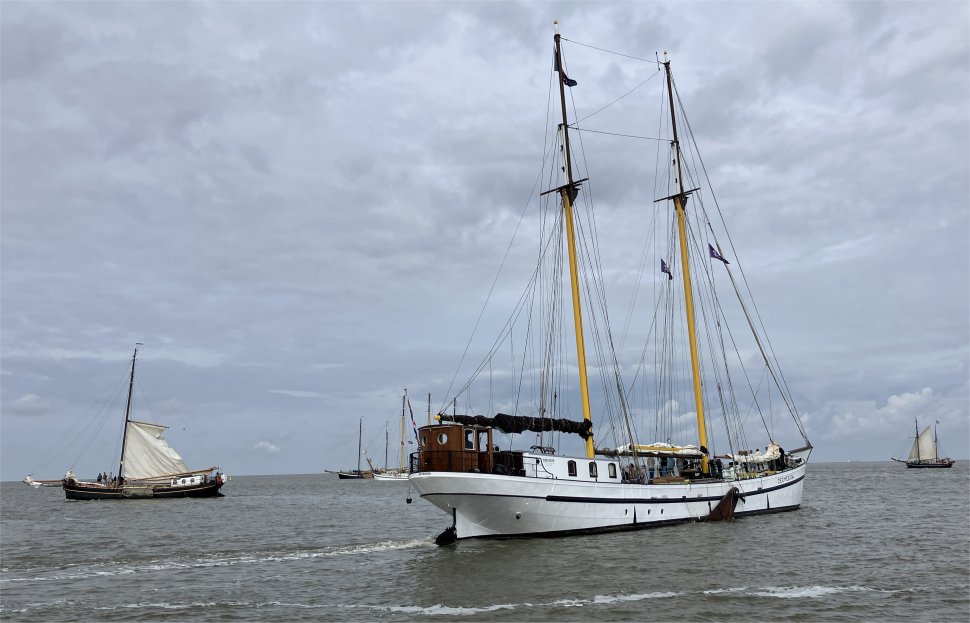 Just a Few of the Tall Ships Leaving Harlingen |
We bounced our way down to Hindeloopen, the sea was choppy and the rain becoming more consistent.
On reaching Hindeloopen, a German boat in front of us crawled through the entrance to the marina, again driving Rex to distraction. We eventually managed to check in and get ourselves moored in a box. We were surrounded by German flags. While Rex napped, I marched off to check the route to the train station (22 minutes' walk away), and then booked us a table at the Sudersee restaurant where we'd eaten many times before.
I then took myself for a walk around this beautiful, quaint, little town, one of the Elfstedentocht (200km long skating tour of the eleven historical cities of the province). Leaving the Hylper Haven Marina, (Hindeloopen Frisians were natively called Hylpers), I passed by the Sylhuis, the lockkeeper's house, together with the leaf bridge in front of it, and the Liars' Bench, where male inhabitants of Hindeloopen still meet and tell big stories.
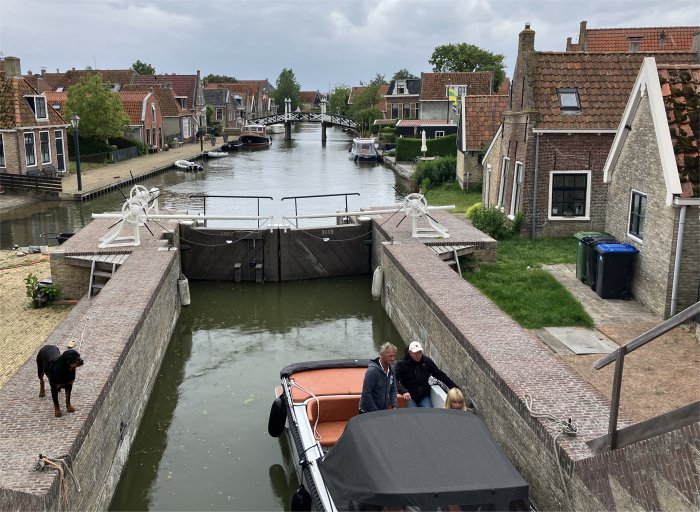 De Zijlroede from the Leaf Bridge |
The shipping trade with Scandinavia, the Baltic states and Russia, together with good relations with the metropolis Amsterdam, brought the population of Hindeloopen a great prosperity. The 17th and 18th centuries were especially golden times. At that time, the people of Hindeloopen spent a lot of money in Amsterdam on precious fabrics and objects, which were supplied through the Dutch East India Company (VOC). The rich town developed in those days her own traditional costumes and a completely individual style with colourful painted walls and furniture. The flourishing trade came to an end in the 19th century when the merchants moved to Amsterdam. Hindeloopen became somewhat impoverished and people were forced to make a living from fishing. Nowadays, tourism features heavily in the town's economy.
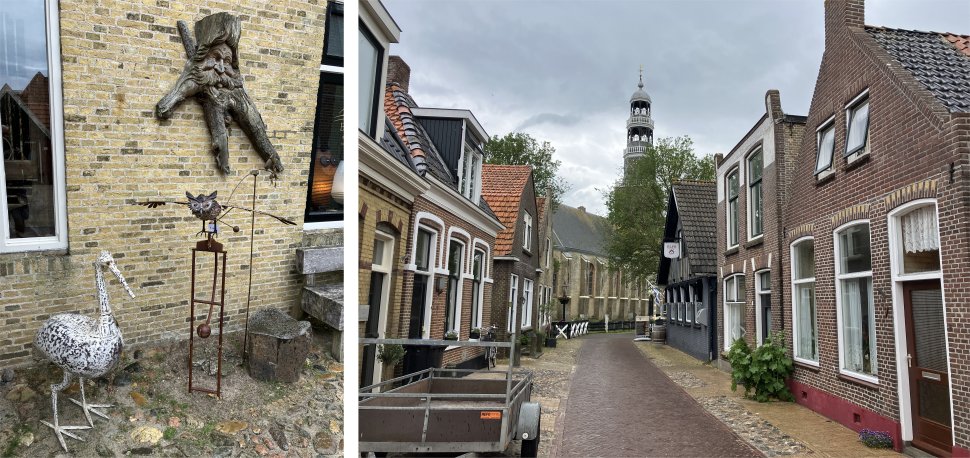 Strolling Down a Wet Buren |
 Grote Kerk |
The town was a maze of delightful, narrow, cobbled streets, festooned with flowers and criss-crossed by small canals. Strolling down the main drag, Buren, a narrow street awash with arts and crafts shops and pancake cafes, I arrived at the Grote Kerk with its tall tower, visible from miles out over the Ijsselmeer. In the Middle Ages a parish church existed in Hindeloopen, but was destroyed in 1570. It was rebuilt in 1593. During the 17th century the population of Hindeloopen grew significantly, and there was a need for a larger building. The old church was demolished and the foundation was laid for a new church building in 1632. More than 25 years later, the church was extended with a south aisle. It was only in 1683 when the tower was equipped with bells. During the years 1970-1975 both the interior and exterior restorations were carried out, and the tower, hanging well off balance, was somewhat "rectified".
Nearby stood the museum which we visited in 2015, and opposite the Grote Kerk stood a 17th century sea captain's house which we toured in the same year.
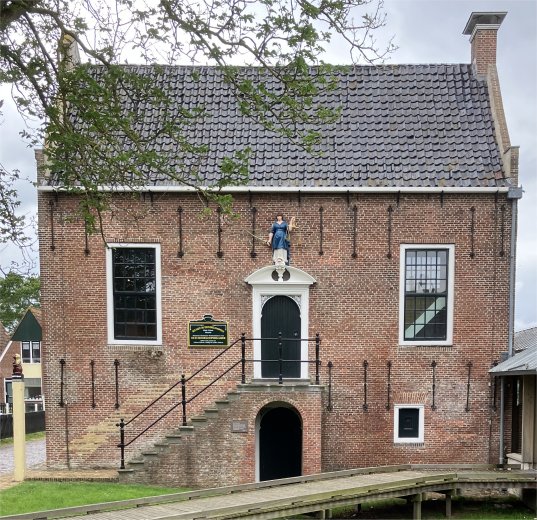 Museum |
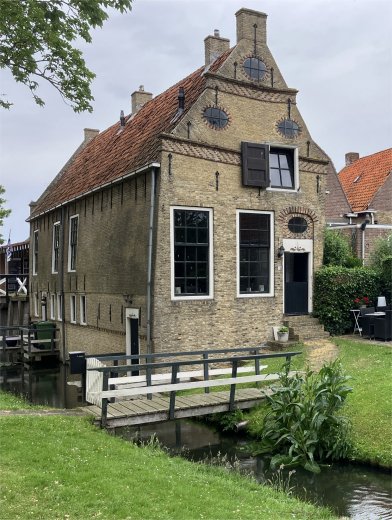 17th Century Sea Captain's House |
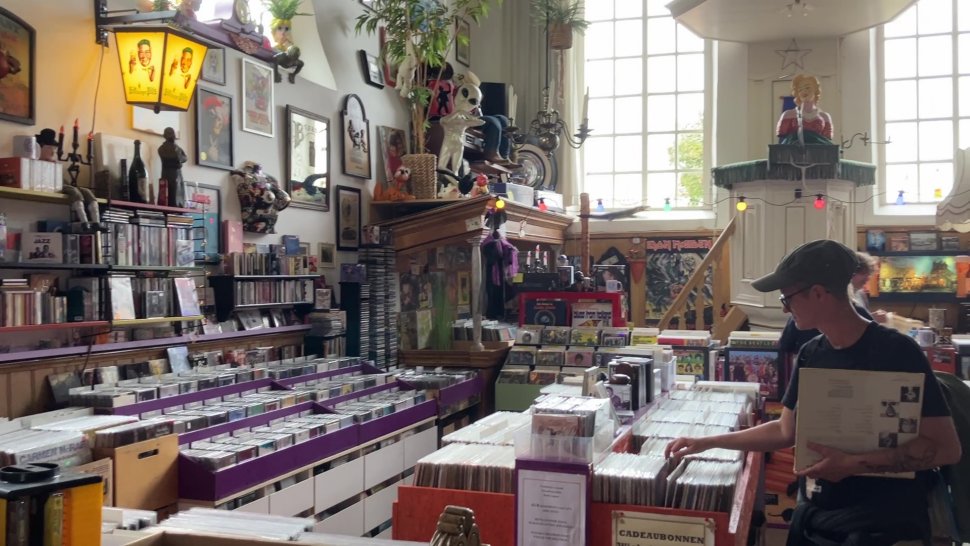 Wiebe's Records |
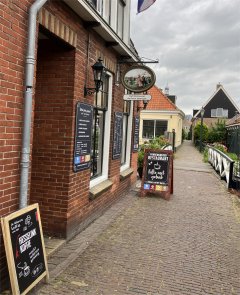 Pannenkoekhuis de Friese (Pancakes) |
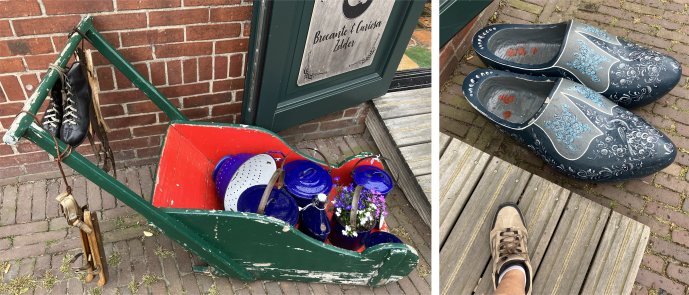 Outside the Frisian Skating Museum |
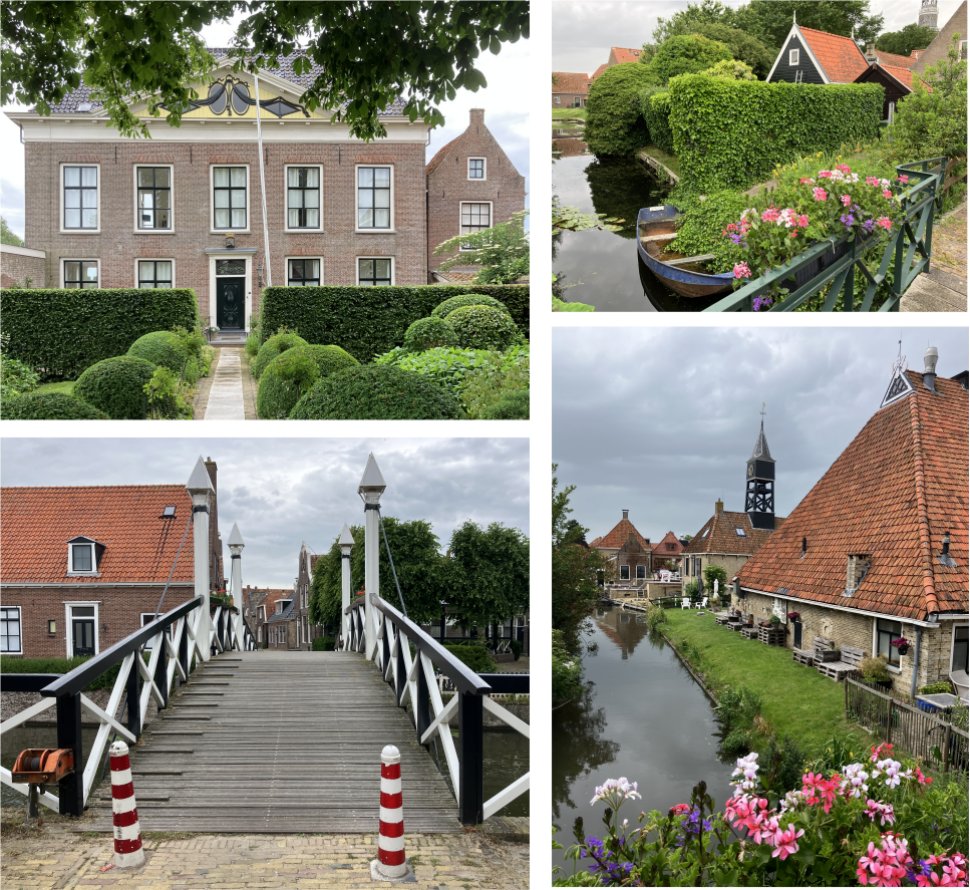 More Hindeloopen Chocolate Box Images |
"Most boats around here are German," said another chap.
"We've already noticed that, that's why we are here to support you," I replied. That raised a cheer and a few laughs.
"Are you here to fight the Germans?" shouted one of the fellows, followed by more cheers.
 Frisian Whiskey Just Prior to Having Water Added from the Ceiling |
In the evening we headed into town and stopped for a beer at the Cafe de Boekanier, Rex always insisted we kept our fluid levels topped up. There appeared to have been a change of management. It was now run by a young fellow and his wife, who seemed to have a running tiff with each other whilst going about their business.
For food we headed down to the Sudersee restaurant which I had booked earlier. We first came here to eat in 2015, and have visited several times since. The food and service are always good there. We watched dozens of swallows swooping past a window adjacent to us snapping up the flies, while a sparrow weaved between the uprights of a rail catching spiders. This was suddenly interrupted by a very heavy downpour. We had a chance to chat with the young fellow who appeared to be running the restaurant. He was actually the son of the owner, Pieter Bakker. He explained he needed to earn enough money to pay his father before he could take over the business.
I was sampling a Frisian whiskey at the end of the meal when I felt an odd sensation on my bare arms. Then we spotted water dripping down from the ceiling. A bucket was promptly brought. I supposed this happened a lot. Not to worry, we were leaving anyway.