
I trooped up to the little shop in the marina to buy some rolls and croissants. I ordered them in my best Dutch, paid the bill, and as I was leaving the Dutch serving lady said, "Dankeschön." Perhaps that was a reflection of the fact that half the boats in the marina were now German. Indeed we noticed that many marinas were now becoming more "German", and the go to language after Dutch in marinas, bars and restaurants in Holland was becoming German. I guess service workers easily detect a speaker isn't Dutch, and nowadays just assume they are German. Sadly, the Germans just refuse to speak Dutch. I find it all rather sad, and I do worry about how the world is changing.
We had scheduled a trip to Sneek today. Rex, Meryl and I had visited Sneek once before in 2013 on our sail from Leeuwarden across country to Stavoren. It would be a long trek for us to sail down to Stavoren in rough waters, and then sail all the way up Johan Frisokanaal and series of lakes to reach Sneek. We took the easy option - the train which travelled between Stavoren and Sneek.
For some unknown reason, Hindeloopen station is a good 20 minutes' walk out of town. I had researched the previous day the route to take, so I took the lead heading up there. It was a pretty route following a small canal most of the way. A knot of natterjack toads was loudly calling each other from the narrow waterway; gulls wheeled above a field of sweet corn which were just starting to grow. Jersey cattle nonchalantly cropped another field, with sheep doing likewise on the other side of the road.
We reached the station, just a short platform and a small shelter to fend off the elements, plus a small copse standing behind the platform, full of bird song. We were the only ones who boarded the train. Our journey took us through a lush, green landscape, criss-crossed with narrow waterways, canals and lakes. Grass had been cut in some fields for silage. The majority of the land was pasture, with herds of Frisian and Jersey cows munching away, which could explain why we passed by a very large milk pasteurisation plant, FrieslandCampina, at Workum.
It was only a short journey to Sneek. Once there we followed the crowd, assuming most folk would be heading towards the town centre along the immaculate Stationsstraat.
Sneek received several city rights in the 13th century, which became official in 1456. Sneek was now one of the eleven Frisian cities. This was also the beginning of a booming trading city that would last until the year 1550. In 1492 they began building a ditch and wall around the city. In those days Sneek was the only city in Friesland that had a wall. Only the Waterpoort and the Bolwerk are remaining today. The city was an important shipbuilding centre as early as the 15th century, a prosperous maritime city protected by an extensive system of walls and moats. This was reflected in today's traditional setting; the old city being surrounded by a diamond of canals. Post-war development has robbed the place of some of its charm but there are still some buildings of interest, notably the grandiose Waterpoort at the end of Koemarkt, all that remains of the seventeenth-century town walls.
Today Sneek is the main centre of an agricultural area, with colleges of agriculture, an agricultural advisory office and a teachers' training college, as well as one of the largest yacht harbours in the country. In summer it is a popular centre for water sports on the Frisian lakes, including the Sneekermeer. At the beginning of August, crowds flock in for Sneek Week, an annual regatta, when the flat green expanses around town are thick with the white of slowly moving sails.
 Rex Heading Off to Theater Sneek for an Audition |
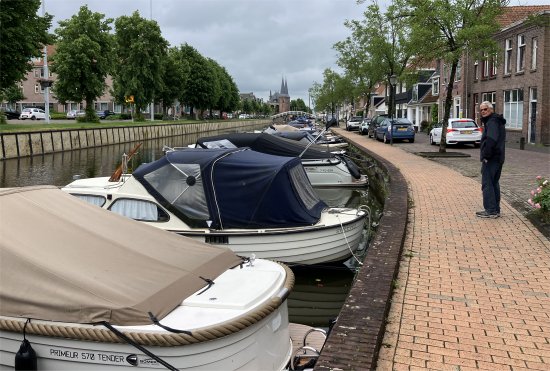 Heading Down Watersingel, Waterpoort in the Distance |
 Waterpoort (Water Gate) |
 Waterpoort |
 Watertoren |
Turning to our right, we followed the canal along Westersingel until we reached the large water basin, De Kolk. Over the water stood a magnificent building, the Waterpoort (Water Gate) of 1613, the only remnant of the town's fortifications, which were demolished in the 18th century. This picturesque old gate bridging a canal consisted of two octagonal towers joined by a kind of loggia. We stood a while on the arch of the Waterpoort, watching large gin palaces entering De Kolk at the head of the Geeuw as far as the Waterpoort, and then turn abruptly right through the raised bridge into the Stadsgracht.
Looking from the Waterpoort, in the distance over De Kolk, the Watertoren could be seen dominating the skyline. The Watertoren was built in 1908 in the Neo-Renaissance style. The 44m high tower, which had a national monument status, contained a 350 cubic metre reservoir. Since 1998 the tower has been used as an office.
 Sint-Martinuskerk |
Heading up Singel, we stumbled across Sint-Martinuskerk, the Roman Catholic Neo-Gothic pseudo-basilica cruciform church, dedicated to St Martin of Tours. The structure from 1872 was designed by the architect Pierre Cuypers However, it remained unfinished. The church has no dominant tower, but rather a roof turret with an octagonal spire betwee four gables, a type of spire that Cuypers used quite frequently. The organ from 1891 was built by Michael Maarschalkerweerd from Utrecht. It was restored in 1997. The stained-glass windows are by Atelier F. Nicolas en Zonen. Sadly, an elderly gentleman appeared to have fallen by a car in the grounds; several Dutch people were in attendance.
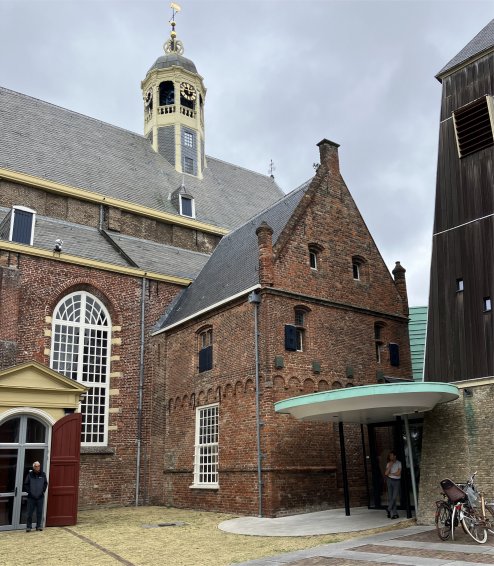 Grote of Martinikerk |
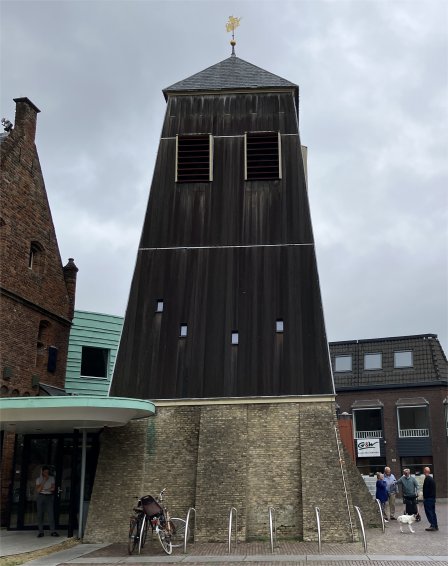 Bell Tower |
The Martinikerk was originally built in the 11th century in tuff stone. Around 1300 the church was enlarged and given three towers in a Romanesque west facade. A freestanding, timber-clad bell frame associated with the Reformed Church. was also added. The bell tower houses two bells: one by S. Butendiic (1466, diameter 102 cm) and one by J. ter Steghe (1543, diameter 117 cm). The present church dates from 1498. In that year the choir and nave were renewed in Gothic style. The sacristy on the south side is from the 16th century and is now used as a consistory room. In 1681, the Romanesque west front collapsed and with it the middle of the three towers; the other two towers were demolished. The badly damaged church was rebuilt, but the towers were not. The places where these towers were located have been made visible in the old cemetery by a raised area.
The church is located on a mound in the centre of Sneek; it is a three-aisled hall church. The church is in present-day use for the worship services of the Protestant congregation in Sneek. In the years 1710-1711 an organ was built on the separation between the church and the choir by the famous organ maker Arp Schnitger on a new gallery. The organ had a principal work, rugwerk, borstwerk and a free pedal. At that time it was one of the largest and most modern organs in Friesland. Twice a week (on Tuesdays and Fridays) at noon, the city carillonneur plays the carillon.
 Former Stadhuis |
Our enthusiasm for Sneek was starting to fade. We headed down Marksttraat, turned right at the bottom into Waagplein, the nearest we'd found that resembled a square, and at the bottom right of the square we plonked ourselves at the Grand Café de Walrus. Drinks and apple pie plus cream all round. Incidentally, when we were here in 2013, the harbour master recommended De Walrus. The food was excellent then, and the apple pie was also excellent today.
 Waagplein Jester |
 Apple Pie at De Walrus |
To console ourselves we headed off to the Cafe de Boekanier for a pre-meal drink. "Sorry, we're shut." The restaurant next door where we have eaten and drank in past times, De Hinde, was also closed. However, the Restaurant De Drie Harinkjes was still open, and we were invited to climb the stairs and drink a couple beers. We sipped them whilst overlooking the Ijsselmeer. The waitress spoke to us in "Dutch", but I found it hard to follow. I discovered she was not speaking to us in Fries, but in a Hindeloopen dialect. Hmm … perhaps this is why the Germans don't try to speak Dutch.
Later we headed back to the Sudersee restaurant again. The young fellow hoping to become the owner recognised us again. We were pampered, the food was excellent, the guy who had brought out a bucket to our table 24 hours earlier came to greet us, and the same bucket man showed us his kitchen afterwards. We'd completely forgotten the laundry fiasco.