
Tall Ship Squeezing us Out
|
Rex stepped into the wheelhouse complaining of the wind whistling up his shorts. He was so overcome he went for a lie down; must be his age.
It was a 4-hour trip across the Ijsselmeer, a little bumpy at times. But when we reached our objective, a large hotel boat and a tall ship squeezed past in front of us; the privilege of size.
We entered the Regattahaven and tied up to the Melden "registration" pontoon. Then, following the usual procedure I hiked off to find the harbour master. He was on his lunch break, of course. We hung around on the boat, watching other souls, accompanied by dogs, trying the harbour master's office, and all subsequently wandering off aimlessly.
Eventually, the man and his assistant appeared. They stood and stared at
Duonita; how dare this craft turn up and tie up to the Melden pontoon in their absence! Perhaps I misread their gaze. Then they opened up and entered their office.
I clambered off the boat but was beaten to the office by one of the couples with their dog. By the time I reached the office, the couple were giving the harbour master their details. "The name is Plummer, P-L-U-M-M-E-R, Plummer," said the chap in a northern England accent.
"As opposed to joiner," I joked. They laughed and legged it.

Grebe with Young
|
I checked us in. "Have you got Wifi here?" I enquired.
"Hmmm.. . no. Perhaps if you try and connect right in front of the office, otherwise no," was his helpful response.
"Do you get many British boats here?" was my next line of enquiry (I had already spotted German craft).
"Hmmm … , last year we had just five British boats stay here," was his extensive reply.
I returned to
Duonita and we headed round to our allotted berth. A Dutchman from a neighbouring berth kindly took our ropes. Scores of grebes and mallards came to greet us. "It is a large marina," explained the Dutchman. "50 % of it is being refurbished. The boat rental section is closed on Mondays and Tuesdays." Safely ensconced, we meandered off to town.
Medemblik was a prosperous trading town, when, in 1282, Floris V, Count of Holland, successfully invaded West Friesland. He built several fortresses to control the region, one of which was Kasteel Radboud in Medemblik, and awarded Medemblik city rights in 1289. After Floris V had been murdered in 1296, the local Frisian besieged the castle, but in 1297 an army from Holland thwarted their efforts to starve out the inhabitants, which included Medemblik citizens.
Several more attacks took place in the following centuries. The most notorious of these happened in June 1517, when Medemblik was attacked from mainland Frisia by about 4000 pirates known as the Arumer Zwarte Hoop, led by Pier Gerlofs Donia and Wijard Jelckama. Many citizens fled to the castle, which the pirates unsuccessfully besieged. Eventually, they took out their fury on the town, which burned to the ground. After this the band continued their marauding path on land throughout present day North Holland.

Stadhuis
|
Medemblik obtained town walls in 1572, so that the castle lost its role as a refuge for the citizens, which led to its partially dismantling in 1578. Over the centuries the castle fell into decay, but in 1889 it became property of the crown and was restored to be used as a courthouse, which function it served until 1934. Anticipating the German invasion, the Rijksmuseum in September 1939 chose the castle as the initial hiding place of Rembrandt's "Night Watch".
Passing behind the Radboud Castle, we walked down alongside the Pekelharinghaven, admiring the large collection of yachts. At the bottom we climbed up to the Hoogesteeg road, turned right and walked between the Pekelharinghaven, Westerhaven and Oosterhaven harbours.
The road dropped down a gentle incline, the Kaasmarkt, and continued as Nieuwstraat, the high street through the town, lined with many 17th and 18th century gables, shops, cafes, restaurants and the inevitable dentist. Strangely I never see a plethora of mobile phone or vape shops, nor barbers and nail bars in Holland. Along one side street we spotted a flurry of orange bunting. Closer inspection revealed a bar plastered with football World Cup posters, "Oop, Holland, Oop" banners, and a gang of Dutchmen outside engaged in jovial banter.
Proudly standing at the far end of Nieuwstraat was the tall, imposing, old Stadhuis against the backdrop of the dike The Stadhuis was built in 1940 to a design by architect AJ Kropholler on the site of the old 17th-century town hall. The building consists of a monumental main building and a recessed side wing, which originally housed a fire brigade garage and two service residences. This wing was later also used for the benefit of the town hall. The town hall is an extension of the Nieuwstraat, so that the building acts as a closure of the main street in the direction of the Ijsselmeer. The elevated location reinforces the impressive impression. The high sloping gable roof with the massive stepped gable gives an even stronger accent to the monumentality intended by the architect. The high pavement (intended to hold speeches, among other things), which can be reached laterally with two opposite stairs, is also intended to give the building great allure. By using the high pavement, the stepped gable, the cross-frames, the placement of the carved municipal coat of arms, as well as in the choice of material, brick and natural stone, Kropholler emphasized the connection with the traditional Dutch form of town hall construction. In this respect the town hall of Medemblik connects with the town halls in Wateringen and Waalwijk built by Kropholler. The main building is made of red brick and has two floors.
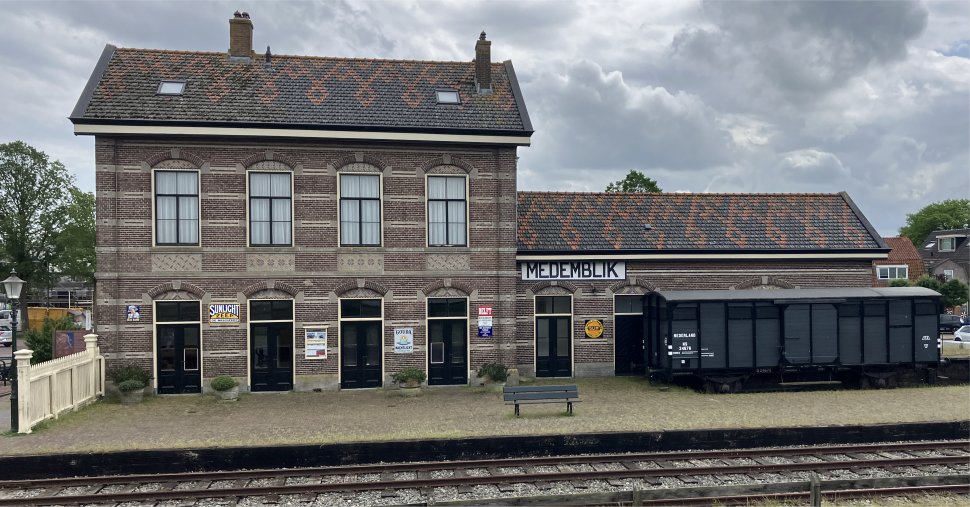
Beside the Stadhuis lay the train station. Constructed in 1887, the Hoorn-Medemblik line connects two proud and historic seaport cities in West Friesland. During the Dutch Golden age in the 1600s, Hoorn and Medemblik were launching pads for the deep-bottomed sailing vessels which made the Netherlands a power in trade and exploration (indeed, South America's Cape Horn honours the city of Hoorn, so named by the Dutch explorers who first reconnoitred the area). By the 1900s, however, silting in the Zuider Zee, Holland's great inland sea, had caused the overseas trade to desert both cities in favour of the North Sea port of Rotterdam. By the time the railway came to link the two towns, the area was more a rural backwater than a centre of commerce. Despite the region's reduced circumstances, the rail line did a good business for eighty years or so, ferrying fish from the two ports and fruits and grains from the nearby farms to the great urban markets at Amsterdam. However, declining traffic volumes placed the line on the closure list in the 1960s. The prospect of abandonment rallied the line's friends, and enthusiasts successfully took over operation of the railway in 1968.
Station
|

Bonifacius Church
|
Martinuskerk
|
Rex, Meryl and I had travelled on this line in 2013, and Rex and I did a repeat visit in 2019. Of course the station was closed today.
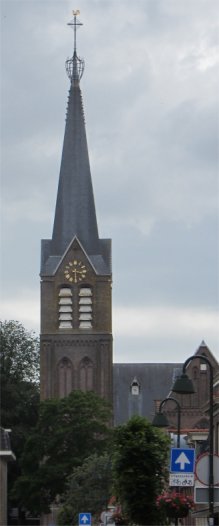
I climbed onto the dike behind the station, and gazed over the town from this vantage point. Two church towers could be seen stretching to the cloudy sky. The nearest was Bonifacius Church, built in 1404 and rebuilt after two fires in 1555. It is a late Gothic hall church with two naves. Despite two fires, the building has largely been preserved. The tower predates the nave and has been leaning increasingly since the second half of the 19th century. Further back stood RK Martinuskerk. Another church was built on this site in 1782 and demolished in 1902. Construction of the present church began in the same year in neo-Gothic basilica style, and was completed in 1903. The church was damaged during the Second World War during the liberation by the Allies. The roof turret sustained irreparable damage. The vanes of the rebuilt 17th -century the Flour Mill De Herder betrayed its presence.
We sat a while on the sea wall, the Zuiderdijkweg, facing the Ijsselmeer. Below us lay a jetty for a ship, the
Friesland, which would be ferrying some of the train passengers to Enkhuizen during the tourist season proper. The large, white Lely pumping station, Gemaal Lely, stood close by where the coast headed due north.
Two display boards were located on the Zuiderdijkweg, covering the demise of two allied aircraft that crashed in the vicinity during World War II. One covered a Handley Page Hampden (AT154): Shot down by a German Messerschmitt night fighter during a bombing raid on Essen, Germany. The crew perished, with several members washing ashore along the local coasts. The other covered a Short Stirling (EH889): This four-engine New Zealand bomber (75 Squadron) was on its return from a mission when it was shot down by a German night fighter. The crew was killed, with twin brothers (Richard and Robert Tod) washing ashore near Medemblik and Andijk.
.jpg)
Handley Page Hampden (AT154)
|
.jpg)
Short Stirling (EH889)
|
We took a leisurely stroll back towards the marina, picking up milk supplies on the way, and walked past the front of the Radboud Castle with its moat. As stated earlier, at the end of the 13th century, Count Floris V of Holland (1256-1296) ordered the construction of a series of castles to control the Westfrisian population. Radboud Castle is the only one remaining of those castles. Of this coercion castle, only two residential wings, two square and one round tower are still standing. From old pictures and archaeological research it is known that Radboud Castle must have been a strong castle. The name Radboud has been derived from the popular assumption that the castle was built on the place where in the 8th century a castle from the Frisian king Radboud had been standing. It is also known as Medemblik Castle. Rex, Meryl and I visited the castle 13 years earlier, but sadly we did not have enough time for a revisit.

Radboud Castle
|
Eetcafé De Kwikkel
|
As we walked by the large slipway at the west end of the marina, we came across the English couple who had pipped me to the post at the harbour master's office.
"Are you in a boat?" I asked.
"No, we are in a camper van; we have booked a pitch in the marina grounds for the night, " replied the chap. "We drove up from Alkmaar today. We enjoy touring around Holland; we just get the ferry from Hull to Rotterdam." Their dog started to show he was getting bored and wanted to move on. "We enjoy travelling in the camper van," added the chap.
Curious about his northern accent, I probed, "You've a northern accent."
"Yes, we're from North Yorkshire - Redcar."
"Where are you from?" enquired his wife.
"I'm from Ipswich, and Rex is from North Essex, a place called Tollesbury," I replied.
"But you haven't always lived there," she added.
"No, you can probably pick up a trace of Cumbrian."
"I thought I could detect the accent. We love the Lake District, and go there quite often," she continued.
Her husband piped up, "Yes, that is where we bought this campervan, in Ulverston actually. We go down there a lot; we like it there. Keswick and all the other places can be reached in a couple of hours."
By now their dog was really barking, he made it clear he wanted to move on. We wished each other a good trip and parted company. Later we spotted their camper van parked on the grass by the marina car park.
Once back on board
Duonita, we were entertained by a large vessel with a crane on its bow on the other side of the pontoon behind us. It was effortlessly pulling out long wooden pilings. The length the pilings had been driven into the mud was amazing. It then effortlessly driving in long steel pilings as replacements.
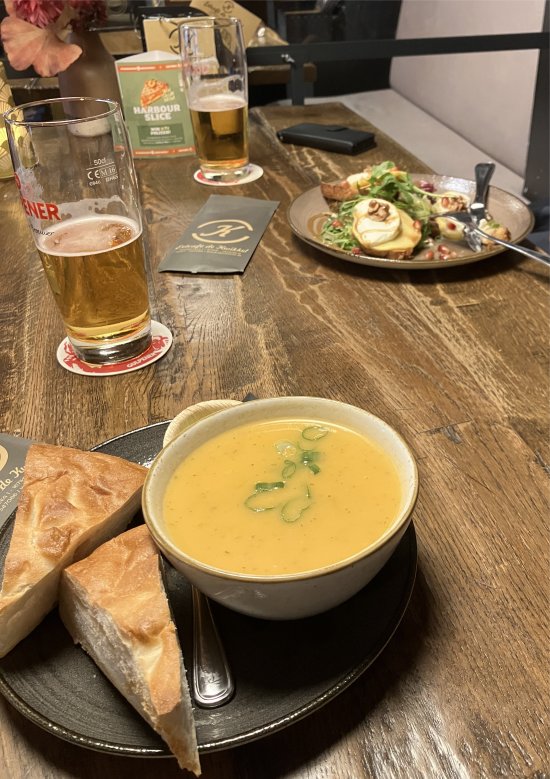
In the evening we headed out in depressing rain, and located the Eetcafé De Kwikkel where the Pekelharinghaven, Westerhaven and Oosterhaven harbours converged. I found the food and service good, though Rex didn't particular enjoy his Sailor's Burger. The place was packed with humans and dogs.
On the table next to us, a German couple sat with their two daughters. It soon became evident that the daughters were annoyed with their father, who had a face like a smacked arse. His wife was trying to smooth troubled waters. Eventually one daughter left. Rex spotted her later on one of his weather checks; she was sitting outside giggling on her phone. Meanwhile dad nursed his small beer, probably ordered hours ago. Oh what fun.

