
 Farewell Medemblik |
Den Oever was a fishing village which developed in the Late Middle Ages on the north-eastern edge of the former Wieringen island. The village is located at the west side of the Afsluitdijk. The Stevin Lock (named after the mathematician and engineer Simon Stevin) and three series of five sluices for discharging the Ijsselmeer into the Waddenzee were constructed in Den Oever.
We reached Stevin Lock at Den Oever, expecting to wait an age to get through. Eagle-eyed Rex spotted a pontoon, so we carefully came alongside it in the now strong wind, and tied up. No sooner were we tied up when the lock gate lights turned green. We hastily slipped our lines and entered the lock as soon as a yacht vacated it.
"I expect we're going to drop a lot in the lock," shouted Rex. Over the next 15 minutes, the water in the lock increased in height by 10cm, and then we were released from the lock. Unbelievably, the two swing bridges that carried traffic to and from the Afsluitdijk started to swing open as soon as we approached them; a tall ship came through from the Waddenzee.
 The Swing Bridge at Den Ouver |
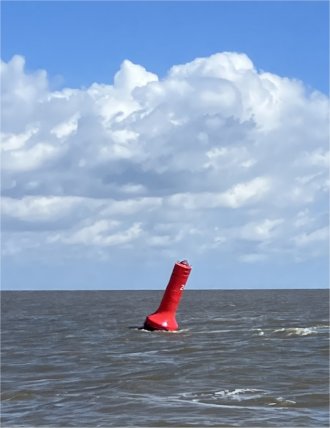 Strong Tide Acting on Buoy |
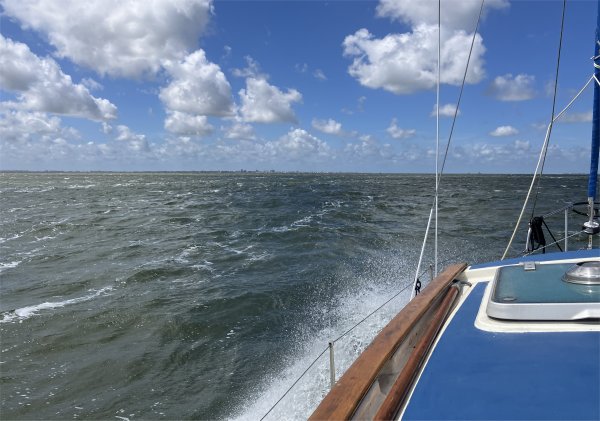 Pounding into the Waddenzee |
The very north east end of Waddenzee, where the German Frisian Islands lie, was the setting for The Riddle of the Sands, a 1903 novel by Erskine Childers. The book, which enjoyed immense popularity in the years before World Wat I, is an early example of the espionage novel and was extremely influential in the genre of spy fiction. It has been made into feature-length films for both cinema and television.
The Waddenzee is notorious for shallow mudbanks. We would have to navigate our way between the Lutjeswaard and Breehorn banks up the Visjagersgaatje, then around the top of the Balgzand bank before turning down towards Den Helder. Fortunately the passage was well buoyed. Very little traffic was about on the water apart from trawlers. The ferry from Den Helder was still ploughing its furrow to and from the island of Texel.
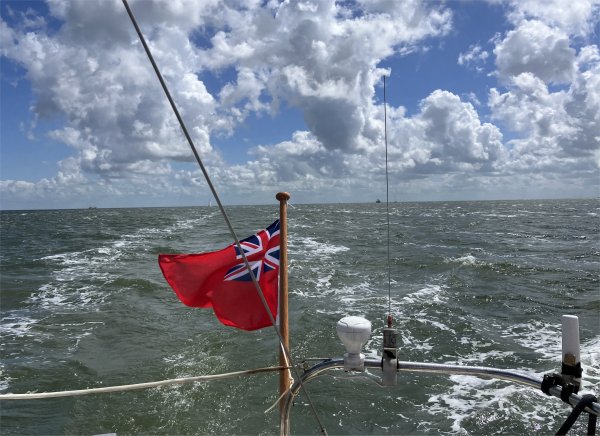 Not Many Out on the Waddenzee Today |
We searched for a hammer head mooring we could tie up to, and as we inched our way towards one in the strong wind, I noticed a man on the quay waving and shouting to us. I could see he was indicating a place further on where we could tie up. I assumed, correctly, he was the harbour master. He greeted us, and helped us with our lines. He looked a strong bloke, but he was struggling to pull the boat against the wind.
"What are you doing sailing in this wind, it is a Force 6.6?" he shouted, and laughed.
Once secured safely, we went off to pay him for a night's stay. He was a friendly chap who pointed out where in the near vicinity we could eat, and recommended De Marine Officiersclub, just a short walk away.
"Have you got Wifi?" I enquired.
"It is poor, very poor, but you can try."
"Also, we intend to travel down the Noordhollandsch Kanaal to Alkmaar and then Amsterdam. Do you know if all the bridges are working?"
"I don't know," was his frank reply.
We thanked the fellow, and with no further ado we headed off to visit the Maritime Museum, which Rex, Meryl and I had visited 13 years earlier.
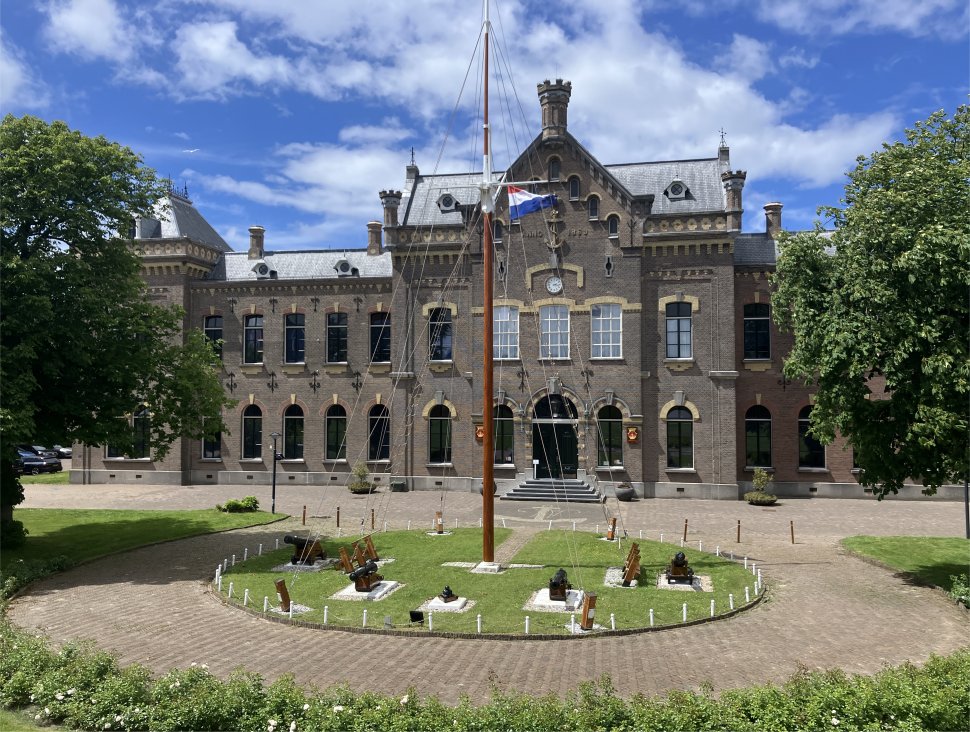 Naval Defence Building |
On reaching the Maritime Museum, located at the Oude Rijkswerf, also known as Willemsoord, an elderly old salt sat at the reception desk; ex-naval serviceman who ribbed us with gentle humour and jokes, as the Dutch tend to do. He greeted us and briefly explained the layout and left us to it. We climbed a flight of stairs and made our way to the Torentje (Turret). The building was commissioned in 1827 as a warehouse for highly flammable substances. Employees were able to see the Turret's clockwork from wherever they found themselves on the dockyard grounds. Now, the six rooms of the Turret tell the story of the Dutch Navy, providing a fascinating glimpse of the complete history of the Royal Dutch Navy, since its establishment some 500 years ago. The exhibition contained paintings, naval guns, uniforms and scale-models of several ships.
Dotted around the grounds, various guns and torpedoes were on display.
The museum also had three ships that could be viewed from both inside and outside: the ram ship Schorpioen (1868), the minesweeper Abraham Crijnssen (1937) and the submarine Tonijn (1966). We did not have a lot of time left, so that constraint plus deteriorating weather limited us to just exploring the Tonijn. Two ex-submariners were on hand to describe the vessel and answer any questions.
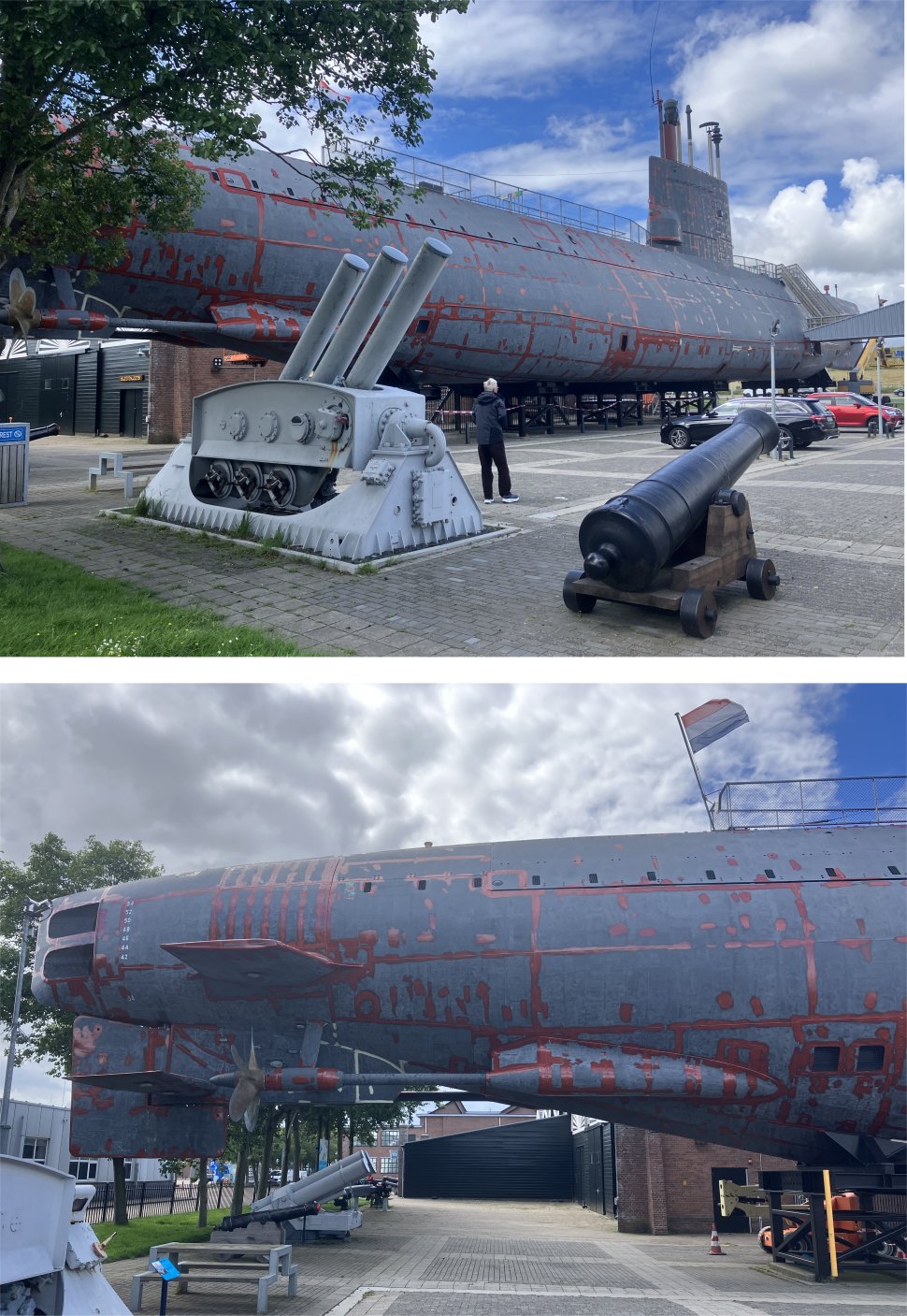 Tonijn |
Built by Wilton-Fijenoord in Schiedam, the HNLMS Tonijn was laid down in 1962 and commissioned in 1966. It featured an unconventional, innovative three-cylinder pressure hull joined together in a triangular shape, which allowed the vessel to dive deeper and operate more stably than traditional single-hull submarines. The upper hull was for the living/working part of the crew and the lower two hulls were for the engines, batteries and storage rooms. This allowed the submarine to dive much deeper than other submarines from the late 1950s, with a maximum diving depth of 200m. The sub operated extensively during the Cold War before being officially retired on January 10, 1991.
Two ships floated in Willemsoord harbour, a large former dockyard of the Royal Netherlands Navy. The minesweeper Abraham Crijnssen was one of eight Jan van Amstel steel class mine warfare vessels built for the Royal Netherlands Navy between 1936 and 1939. Named after the naval hero who conquered Surinam in 1668, the Abraham Crijnssen was officially commissioned in 1937. At the outbreak of the Pacific war (1941) Abraham Crijnssen and several of her sister ships were operating in the Netherlands East Indies. By February 1942 the situation in Java had become critical as Japanese forces gained air superiority and control of the sea. In the face of crushing naval defeats during the Battles of the Java Sea and Sunda Strait a general evacuation was ordered and the remaining Allied vessels began to withdraw in an attempt to reach Australia. Pieter De Bitter was scuttled at Sourabaya on 2nd March to prevent her from falling into Japanese hands, Eland Dubois was scuttled on 8th March and Jan Van Amstel was sunk by the Japanese destroyer Arashio on the same day following an unsuccessful attempt to break through the Lombok Strait into the Indian Ocean. Only Abraham Crijnssen succeeded in escaping, and only by sailing close to the coast at night and hiding, camouflaged with trees and foliage, by day. She eventually reached Fremantle on 20th March 1942. She was the last vessel to successfully escape from Java.
Although not designed as an ocean-going vessel, the Abraham Crijnssen performed vital escort duties for convoys on passage along the eastern Australian coast. She was low slung, with a flush deck and shallow draught. This, combined with a heavy steel pole mast with a 20-inch search light mounted on top, all contributed to her pitching and rolling heavily in rough weather. During one period of particularly rough weather in early 1943 LEUT Chapman recalled that "it was all we could do to look after ourselves, let alone the convoy".
 HLNMS De Ruyter (F806) Bridgehouse |
Her career as an active warship ended in 1906. She was converted into an accommodation ship. As such, Schorpioen served as a floating barracks for naval trainees, and later, submarine forces and torpedo gunner personnel. At the beginning of WW II, she fell into German hands and was used for demobilization purposes and later as an accommodation ship for the Kriegsmarine Ausrustungsstelle. After the war she was towed from Hamburg to Den Helder, where she was again used as a floating barracks for technical training students and later for the Dutch Naval Women's Department, and finally as a boarding school. A seven-year restoration to transform Schorpioen into a museum ship in Middleburg was completed by a private foundation 1990. In 1998, the Royal Netherlands Navy purchased her back and moved her to the Dutch Naval Museum.
Meanwhile, back in the grounds, the bridgehouse and gun turret from HLNMS De Ruyter (F806) were preserved. Named after Admiral Michiel de Ruyter, who defeated the Spanish, Swedish, French and English in a series of daring exploits, the guided missile/air defence frigate served from 1976 to 2001. The bridge and command centre were still fully equipped including the huge radar dome, several metres in diameter. Using this device, it was possible to track as many as 100 targets simultaneously, up to a distance of 400km. This excellent exhibit gave a glimpse of the high-tech state that had been reached in recent years.
The weather was now miserable, and copious amounts of rain were sheeting down. We took shelter for a while under the submarine, as did many other groups who were touring the museum.
We sought refuge in another building, the Ordnance Repair Shop, that contained more naval artefacts and manufacturing exhibits. Details of navigational and communication systems were displayed, as was a Lynx helicopter, aerial and underwater drones, together with lots of hands-on equipment with a large wargaming-room to keep us amused, together with an exhibit demonstrating the Dutch naval involvement in international crisis, particularly the Somali pirate issues.
Sadly, closing time closed in on us, and we departed back to Duonita. We both thoroughly enjoyed visiting the grand museum again.
In the evening, we dressed up as smart as we could and walked to the nearby De Marine Officiersclub. As we entered, various elderly dignitaries were standing around in one large dining area, more than likely all ex-mariners on a reunion. Around a corner we came across a solitary sea captain in full uniform eating in another dining area. He nodded and welcomed us. Around another corner a different dining area contained another captain sharing a meal with a civilian, and another couple sat a few tables away. Beyond this dining room, a large private room contained a gathering of folk about to start their meal.
A tall, slim senior waitress left them and came across to us. She welcomed us, was very amiable and oozed charm, spoke perfect English, and was clearly in command. She showed us to a table in yet another dining area, and soon a young waitress was taking our order for drinks.
I quickly established that they only served small beers, though I couldn't completely understand what she was trying to say. Rex asked for one type of beer, and I thought I said I'd have one of the same, so "Two of those please." Shortly afterwards Rex received his beer of choice while I received two beers of a different variety. I gave up. The food, service and surroundings were really excellent.
Back on board Duonita, a session of Sorry I Haven't a Clue was enjoyed before sleep beckoned.
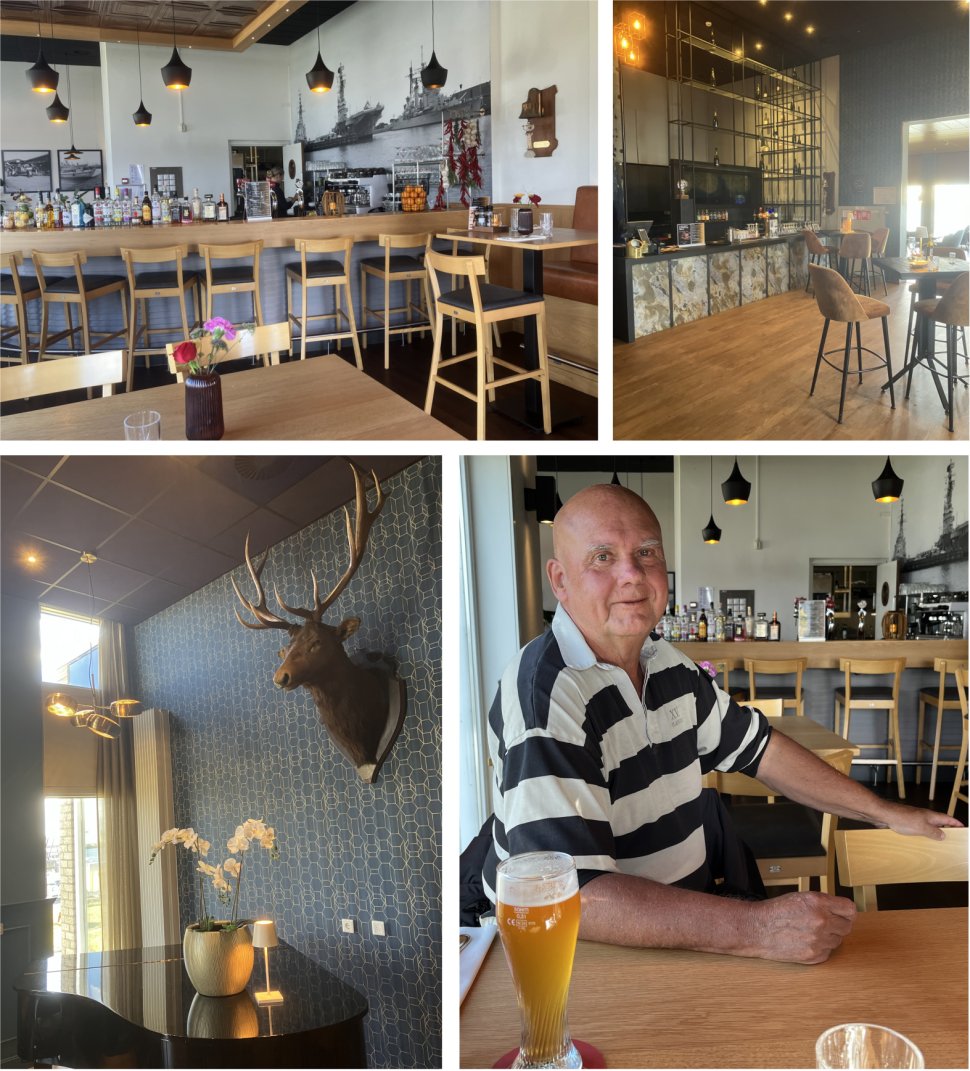 De Marine Officiersclub |